Synthetic Genomics
Designing BioXp’s camera, motion, and thermal hardware
Senior Systems Engineer · 2013–2018
BioXp built custom DNA automatically from shipped reagent plates (Oligo Vaults) holding pools of oligonucleotides—the short strands assembled into full genes. Before starting a run, the machine had to confirm which reagent plate was loaded and verify that its security seals were intact.
During core BioXp development in 2014–2015, I designed the complete internal camera-and-lighting module for that inspection, along with the CNC-machined adapter linking two motion axes and the thermal-cycler assembly beneath the reaction deck.
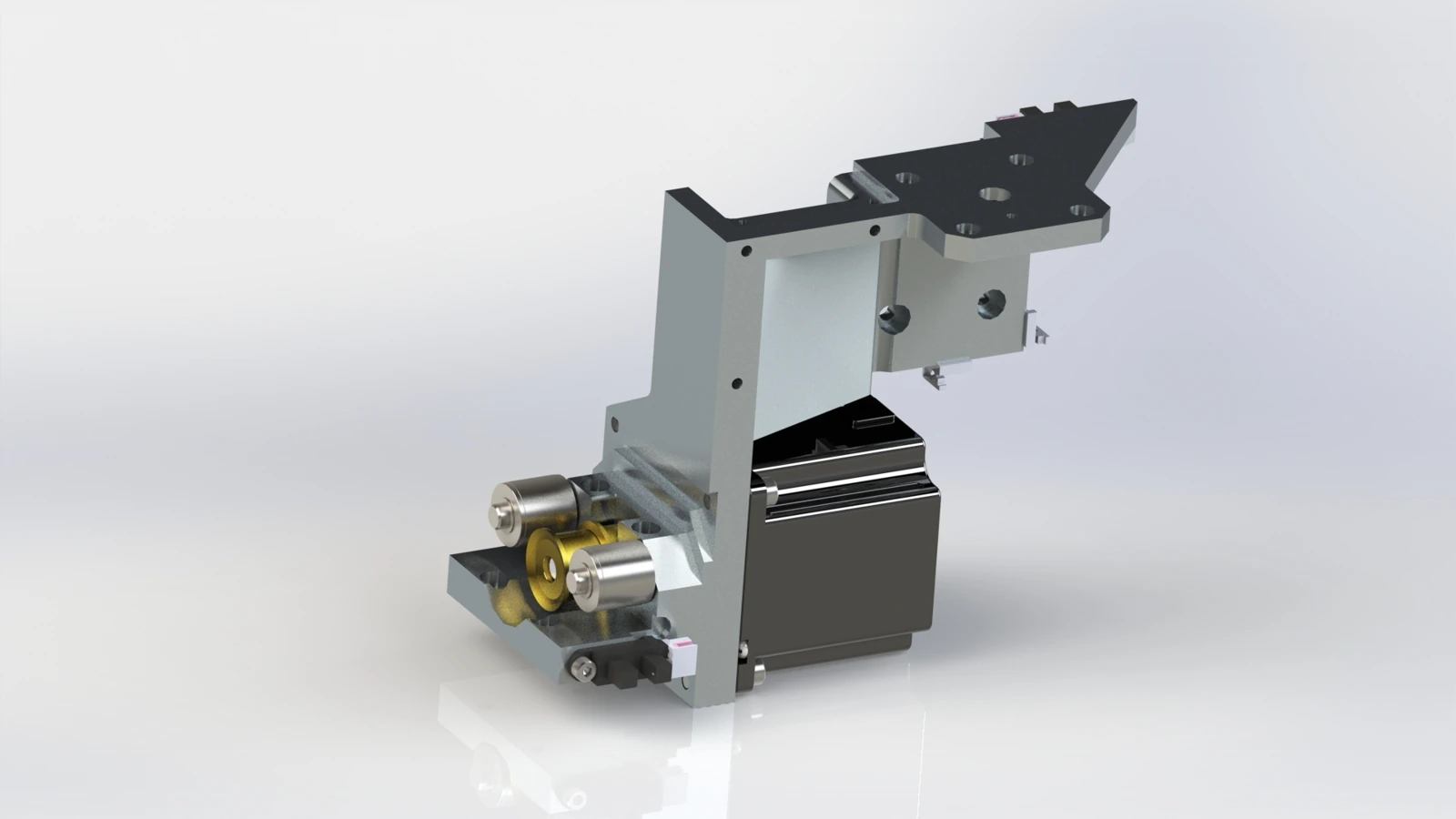 Enlarge imageEnlarge: CAD assembly of the BioXp Y-Z motion stage and camera mounting structure.
Checking identity and tamper evidence
Each Oligo Vault secured up to 96 pools of short DNA strands, and biosecurity was a real design constraint: we had to guard against someone peeling open a cassette and substituting unauthorized biological material.
Reading a valid barcode alone couldn’t prove a cassette hadn’t been opened. The assembly paired the barcode with a breakable security seal designed to tear or distort if disturbed, plus an ultraviolet security pattern verifying label integrity. I am a named co-inventor on the resulting tamper-resistant assembly patent, U.S. Patent 10,017,306, granted in 2018.
Putting the optical package inside the instrument
Space inside BioXp was tight, and one compact optical package had to handle barcode reading, UV-pattern illumination, and physical seal inspection together. I designed the housing, circuit board, and dual-mode illumination, testing and qualifying the board assembly on the bench.
Integrating the LEDs directly onto the camera circuit board eliminated separate light fixtures and wiring, while the housing progressed from 3D-printed prototypes toward injection molding as the instrument matured.
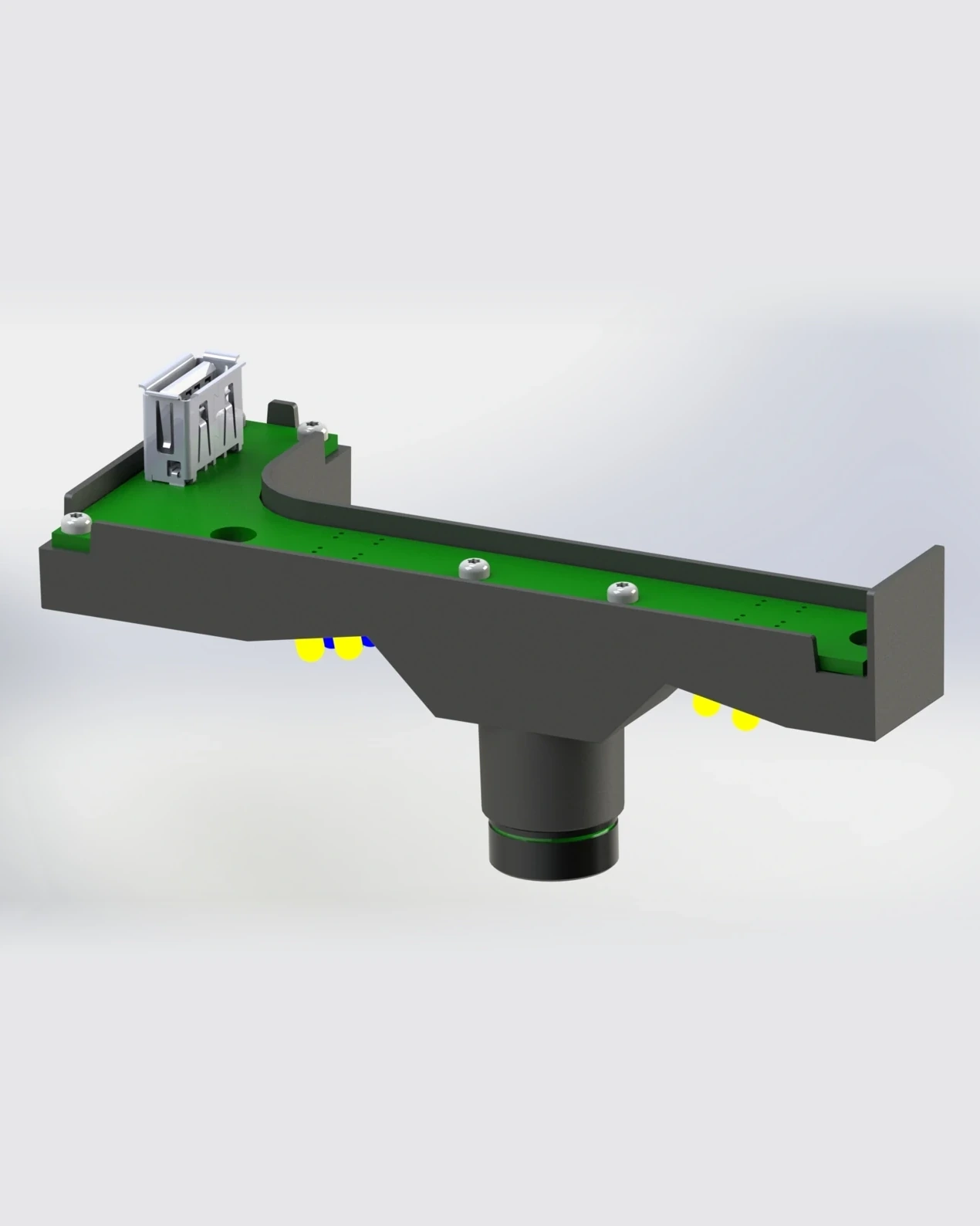 Enlarge imageEnlarge: CAD assembly of the compact BioXp optical package, combining the L-shaped circuit board, dual-mode LED illumination, and lens housing.
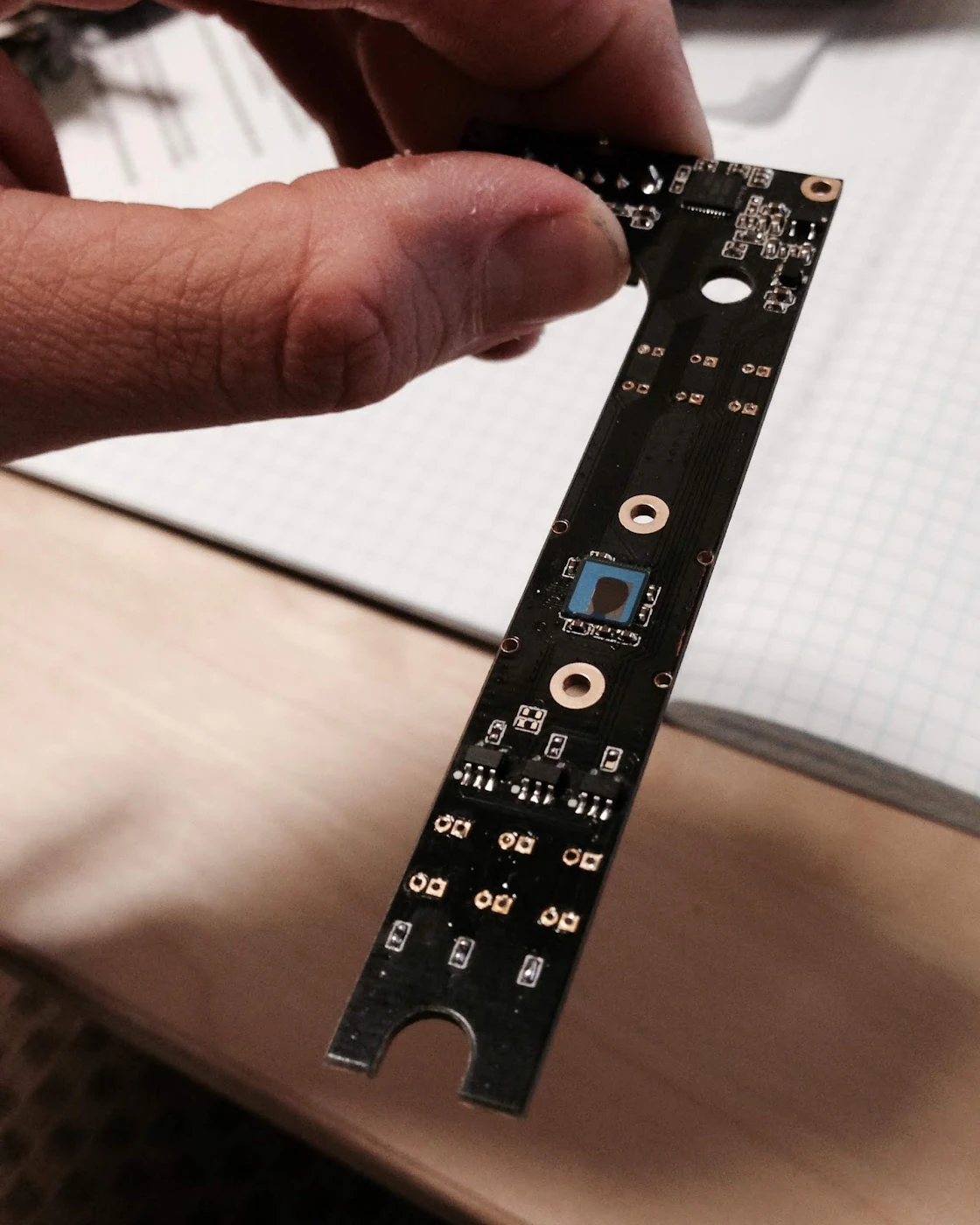 Enlarge imageEnlarge: Fabricated BioXp camera and illumination PCBA on the bench, showing the board-mounted image sensor, LED array pads, datum holes, and slotted locating tab.
Connecting horizontal and vertical motion
Early BioXp prototypes needed two separate brackets to join the horizontal (Y) carriage to the vertical (Z) motion assembly. I consolidated them into a single wraparound adapter nested cleanly around the drive motor, comparing casting against machining with the team and selecting CNC machining to hold tight alignment without upfront casting tooling.
The adapter, alone and around the motor
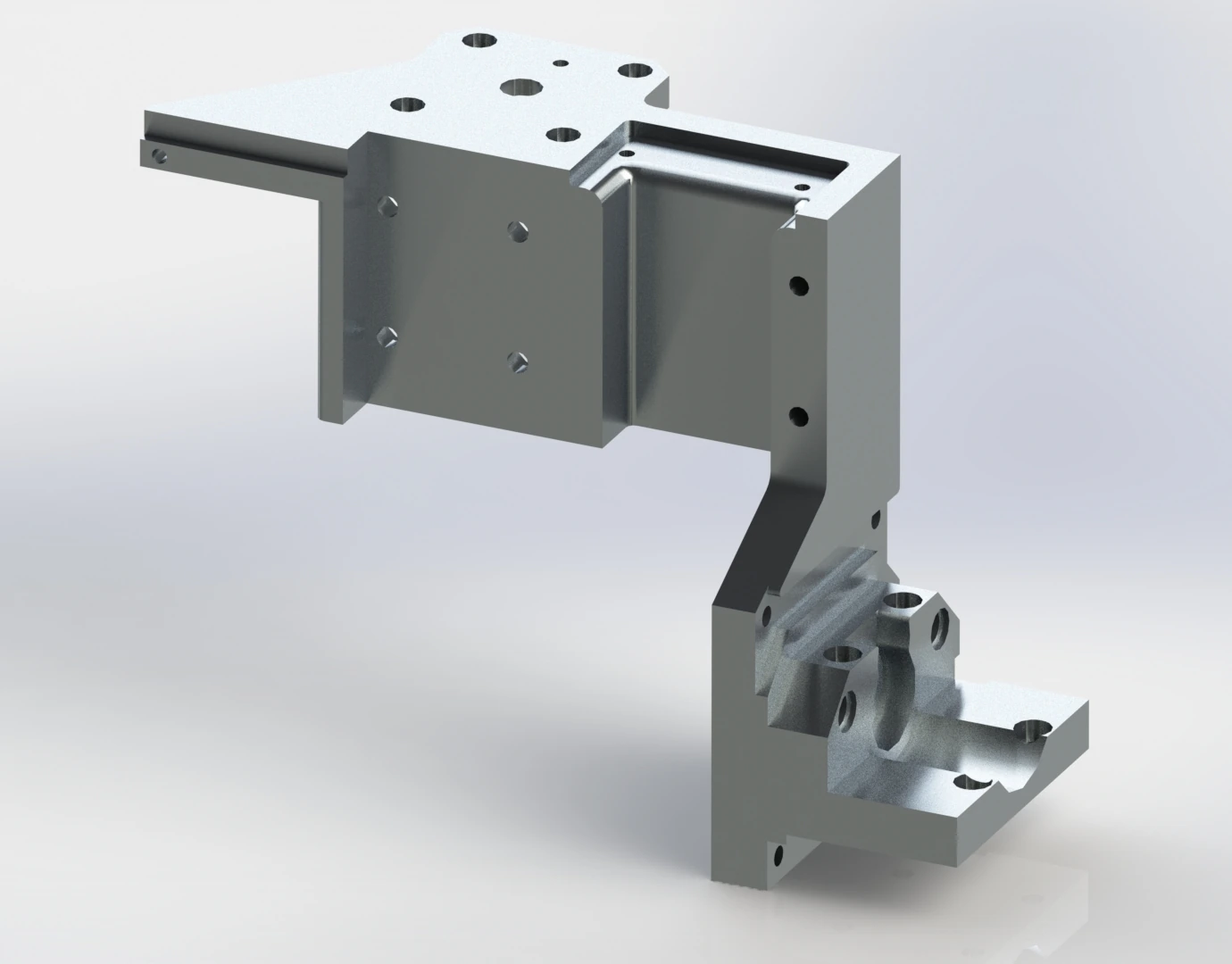
Assembly detail · opposite view
Adapter · Motor · Enlarge original renderingEnlarge the original complete assembly renderingControlling temperature on the deck
I designed and bench-tested the thermal-cycler hardware that heated and cooled biological reactions on BioXp’s deck, working alongside firmware and software engineers who integrated closed-loop run control.
Because software alone should never be the final safeguard against runaway heating, our protection architecture paired firmware temperature monitoring with an independent, single-use hardware thermal cutoff mounted directly against the heated block. If temperatures climbed abnormally, firmware cut the drive signals; if a control fault ever bypassed firmware, the thermal cutoff disabled the drivers through a direct hardware path.
To prove that backup worked in the real world rather than just on a schematic, I defined fault-injection tests that deliberately bypassed individual control points—including short-circuiting a driver into its enabled state—to verify that the independent protection tripped cleanly while resolving supplier and integration updates across the assembly.
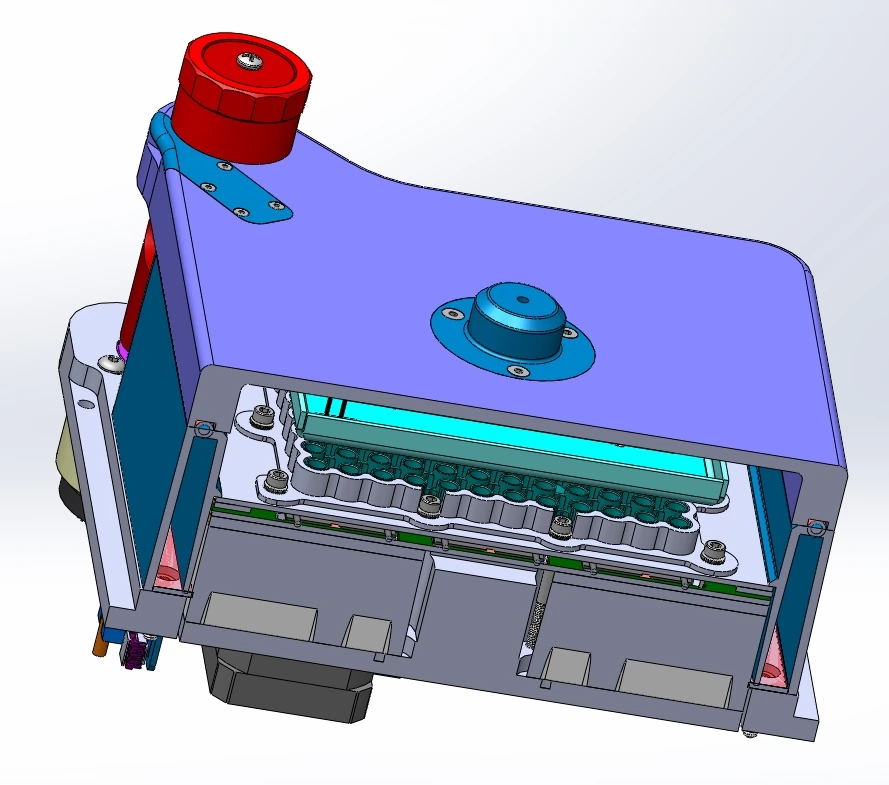 Enlarge imageEnlarge: Thermal-cycler assembly with its lid and reaction area.
Experience used here
Mechanical and electrical design · Camera and illumination integration · Consumable verification · Tamper-evident design · Prototyping · Instrument integration