Life-science reagents
Racer Biosciences
President and General Manager · Consulting · 2025–2026
Building the business around a new laboratory reagent
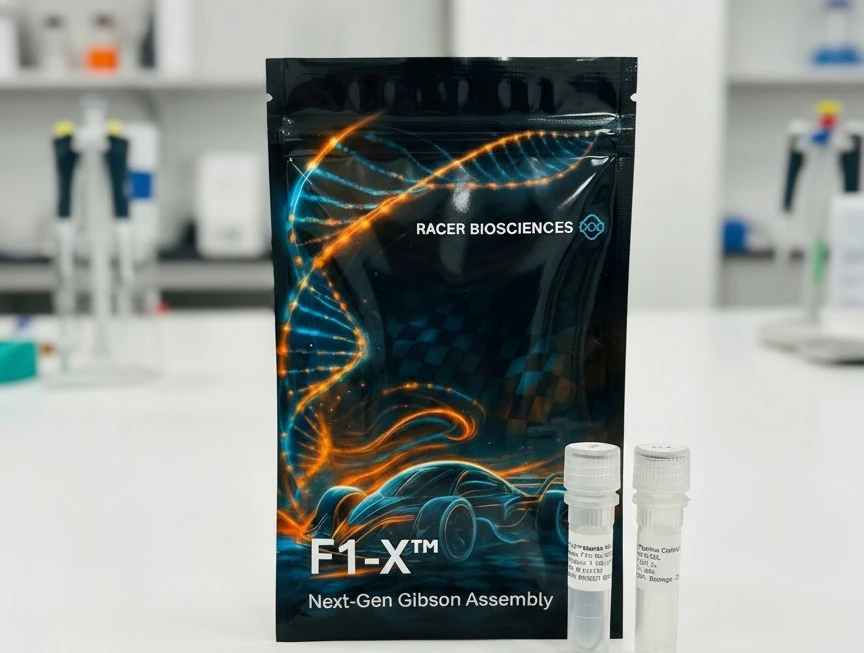 Enlarge imageEnlarge: Racer F1-X reagent pouch beside two sample tubes.
When biologists work with DNA, one of the most common tasks is joining several smaller pieces of DNA together into a single sequence. Our team at Racer developed F1-X, a chemical mix that lets researchers join those pieces in a single step. Having a working formula in the laboratory was the starting point; my job was to build the business and operations around it so researchers could discover it, test it, and buy it.
As President and General Manager in a consulting role, I ran the commercial and operating side of the company alongside another member of the team. I set up the laboratory and production systems, wrote our first quality manual, negotiated six signed distribution and marketplace agreements, handled direct university sales, and directed AI coding agents to build our custom storefront, quality software, and customer-discovery tools.
Signed channel agreements
Four regional distributors across the US, Europe, and Japan, plus two procurement marketplaces.
First distributor & university sales
First distributor stocking order in Feb 2026, custom storefront in Mar, university POs and Japan stocking order in May–Jul.
Software spend avoided
Custom in-house production and lot-traceability app tracking every kit to raw materials.
Finding laboratories with a reason to switch
Most biology labs already rely on a DNA-assembly kit they trust. Rather than guessing from a lab’s general field, I built software that read the experimental Methods sections inside thousands of open-access papers and grant awards, verified the lab head’s email, and drove targeted sample outreach—feeding tester feedback straight back into R&D priorities and guiding academic buyers through university purchase orders and campus stockroom pitches.
Explaining the product and making it easy to buy
A researcher wants clear experimental proof, while their university’s purchasing office usually requires an approved vendor account and a Net 30 purchase order rather than a credit card. I rebuilt Racer’s site as a custom storefront wired to Shopify and HubSpot to support both, and partnered with a teammate on a recurring LinkedIn science-story series backed by an automated drafting pipeline that respected her bench time.
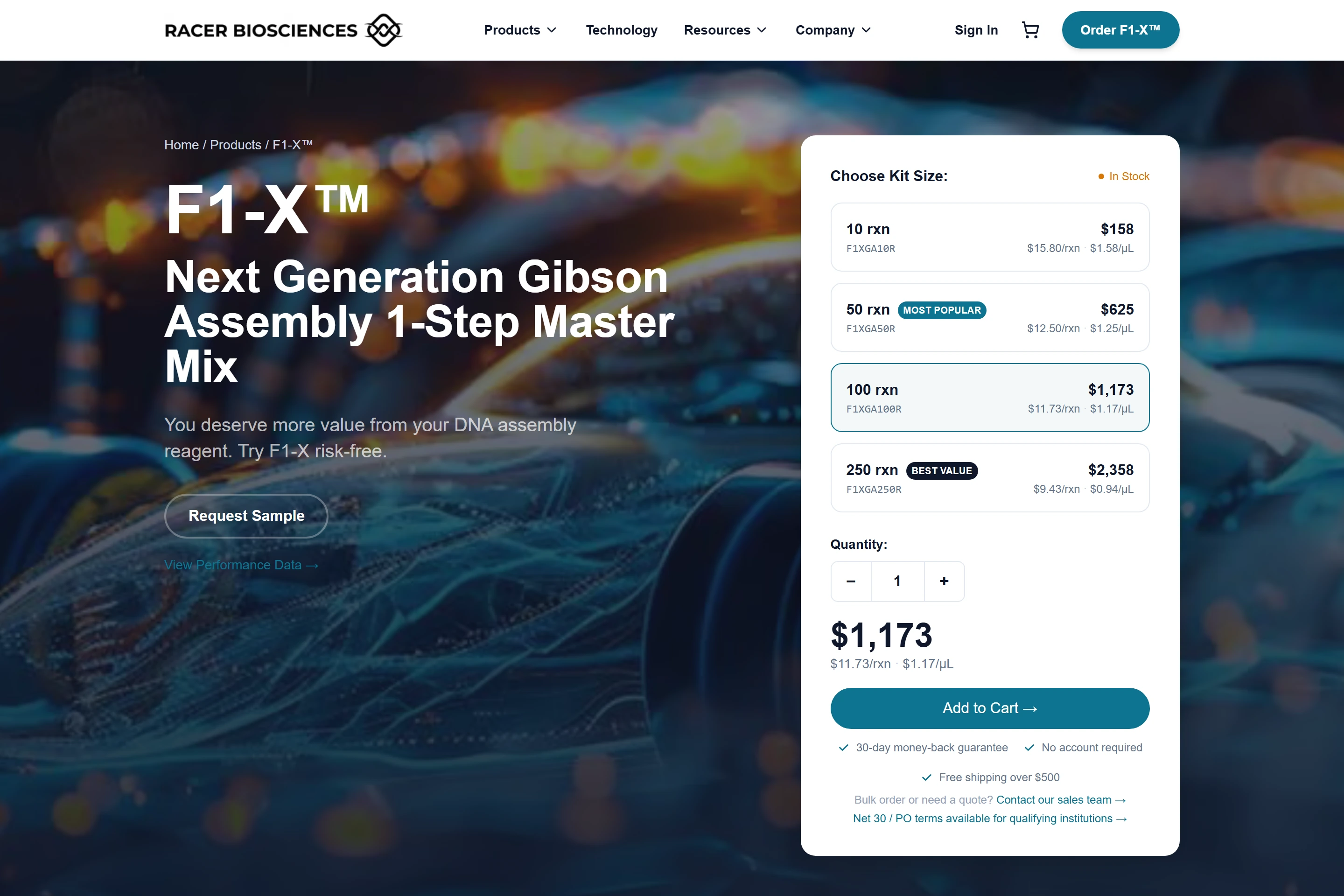 Enlarge imageEnlarge Racer Biosciences F1-X storefront and kit ordering interface
Reaching customers through distribution partners
To reach labs that buy through established vendors, I mapped where competing cloning products were sold, negotiated six non-exclusive distribution and marketplace agreements across the US, Europe, and Japan, and coordinated partner training and catalogs. When feedback revealed that our reaction-count labels made F1-X look pricier per microliter than competing kits, I led a company-wide kit-size and pricing reset across every contract, catalog, and stocked partner.
Setting up production and quality records
After modeling showed that manufacturing in-house beat hiring a contract manufacturer, I helped secure lab space, built an auction scanner to buy used equipment, audited our ERP bill of materials line by line, wrote our first quality manual, and built the web app the team used to trace controlled documents, raw-material lots, and batch records through cold-chain shipping.
Starting an assembly design with the DNA a lab already has
Alongside the reagent business, I worked with a teammate to build an internal beta of a DNA-assembly design tool using AI coding agents. Instead of assuming a researcher was ordering every piece of DNA from scratch, the tool started with what they wanted to build and the DNA they already had in their freezer—checking which pieces could be reused, which fragments needed to be ordered, and whether the sequence had structural issues that would make it hard to assemble. My teammate set the chemistry and manufacturability rules, while I turned the workflow into a working internal prototype.
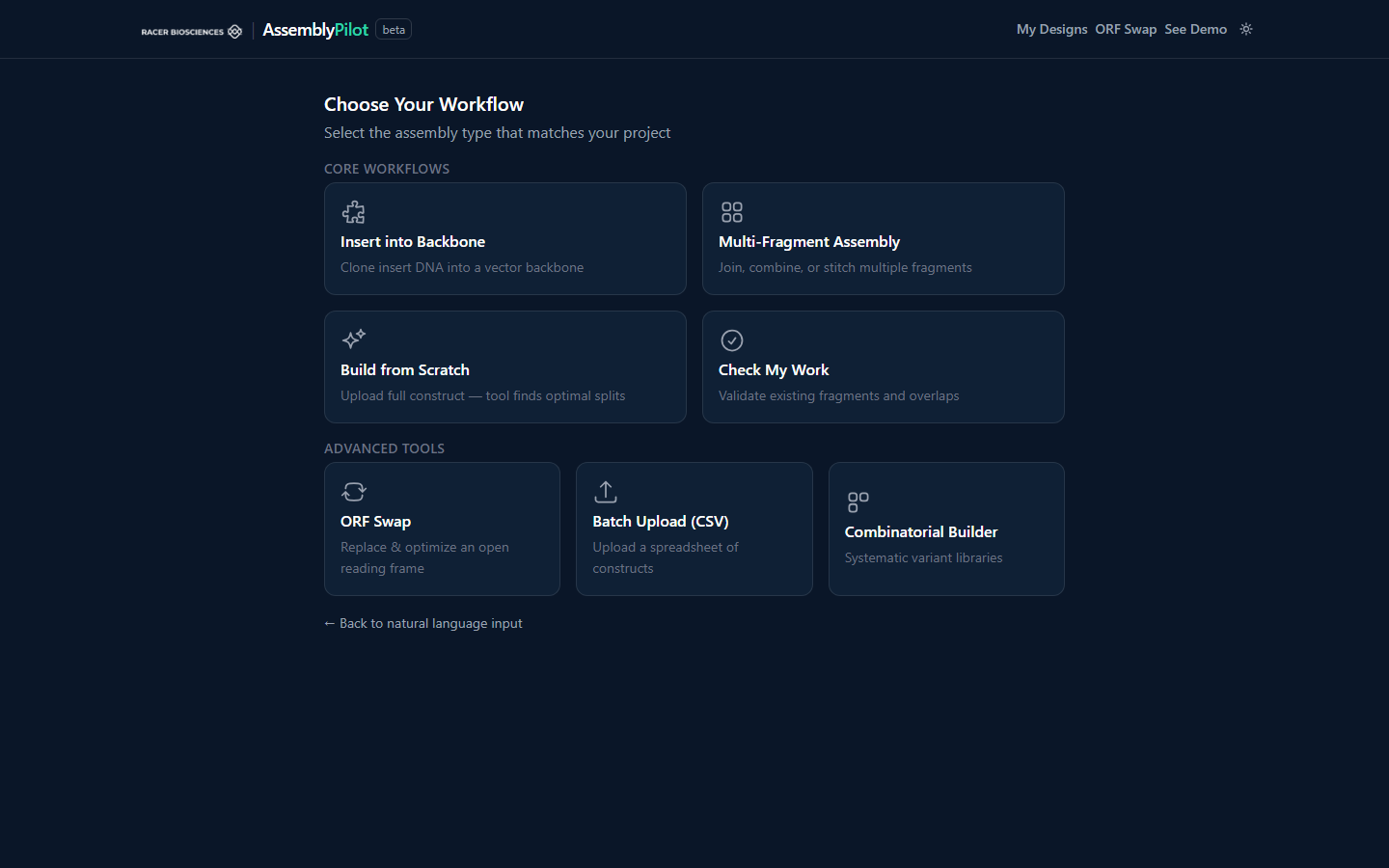 Enlarge imageEnlarge AssemblyPilot workflow choices
Matching our R&D roadmap to bench capacity
With one teammate handling all of the laboratory work, our biggest constraint was her bench time: she was developing new products while also handling quality testing, customer support, and technical content. Six different R&D projects were competing for her schedule.
Rather than asking her to maintain a complicated financial spreadsheet, I built a straightforward project planner where she could enter the tasks, weeks, people, and supply costs for each idea. The model made the bottleneck unmistakable: the proposed projects required far more bench work than her schedule could support. I also pushed back on top-down market estimates, showing why a large industry market didn’t automatically translate into near-term sales for a small team.
I brought that same discipline into our regular management and board reviews—backing every slide with a workbook of primary sources, separating signed distributor agreements from partners actively placing orders, and keeping our hiring and R&D choices tied to the business we could actually support.
Experience used here
General management · Commercial strategy · Customer discovery & direct sales · Scientific marketing · Global distribution · Financial & capacity modeling · Quality & manufacturing systems · AI-assisted software development