Racer Biosciences
Finding DNA-assembly customers in their published research
President and General Manager · Consulting · 2025–2026
Racer began with no customer list. Looking up a biology laboratory’s general research area—like neuroscience or oncology—doesn’t tell you whether that lab actually stitches DNA constructs together at the bench. The real proof sits buried inside the “Methods” sections of their published papers.
I built software with AI coding agents to read those Methods sections at scale, find the laboratories actively doing DNA assembly, verify the right decision-maker’s email, and turn that outreach into sample evaluations and university sales.
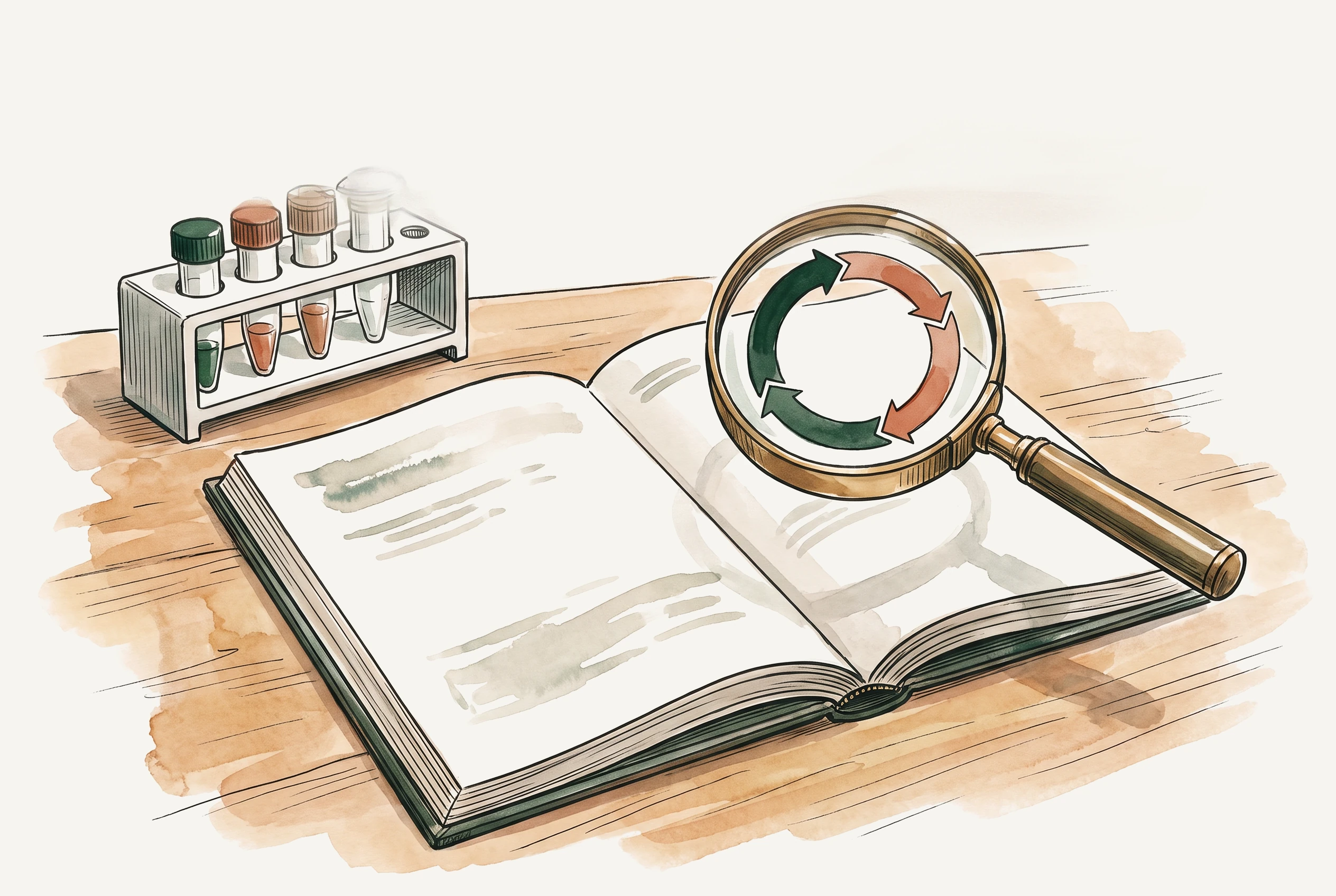 Enlarge imageEnlarge: Pen-and-ink and watercolor illustration of a magnifying lens over an open research publication revealing a multi-fragment plasmid assembly diagram beside reagent tubes.
Reading beyond the abstract—and catching the co-author email trap
Scientific abstracts rarely mention which chemical kit a researcher used to assemble DNA. To find real users, I built a pipeline that pulled leads from published papers, plasmid-repository depositors, NIH grant winners, and small-business biotech awards. When an early AI web-search filter proved too expensive to run across thousands of grants, I shut it down and replaced it with a free script that scored the Methods sections across thousands of open-access papers from those labs for active DNA cloning.
Finding a relevant lab was only half the problem; we also had to reach the right person. When I audited the email addresses automatically extracted from scientific papers, I discovered that roughly 70% belonged to graduate students or co-authors rather than the faculty member or lab lead who ran the laboratory. I added automated name-matching and university directory checks to fix those records before outreach went out, producing verified lists of academic and industry leads.
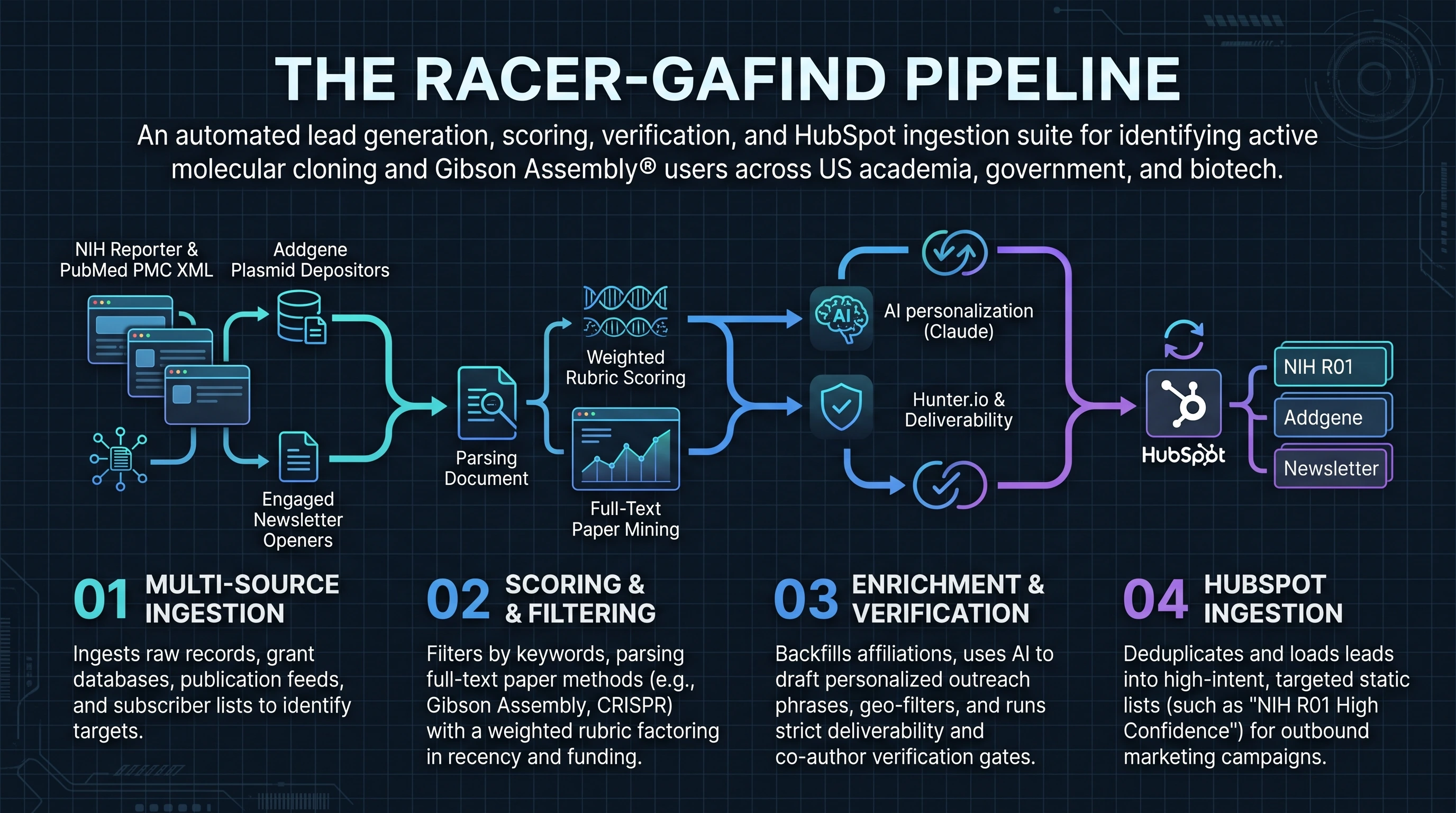 Enlarge imageEnlarge: The Racer-GAFind Pipeline — Finding DNA-Assembly Customers Inside Published Research
Starting a specific conversation
Because we knew what each laboratory worked on, our outreach didn’t sound like a generic cold email—it referenced their research focus and offered a free sample to test on their own constructs. I set up HubSpot to separate academic labs from biotech companies, track six distinct outreach sequences, and log every sample shipment and follow-up step.
When the first small batch of academic emails showed a strong open rate (around 40%) but zero clicks, I traced the drop-off to a plain, unappealing link at the bottom of the message, rewrote the call to action, and added a direct one-click sample request link to the site.
From evaluation feedback to university purchase orders and the campus stockroom
Getting a sample into a freezer was the start of a technical and commercial conversation. When one industry evaluator reported that their first multi-fragment test produced no colonies, I confirmed that other samples from the same lot had worked and wrote to them personally—proposing to run their fragments in-house with another member of the team so we could troubleshoot together. Another corporate evaluator needed the reagent to work with shorter (20-base-pair) overlaps before switching—feedback I brought directly into our R&D prioritization so our teammate could make short-overlap performance her top development goal.
When researchers validated their samples and wanted to buy, I guided each order through their institution’s purchasing rules:
- Fulfilling our first university purchase order: For our first order at a nearby research university, I matched the quote, created the Net 30 draft order, resolved a sales-tax question, submitted the invoice through the university’s e-invoicing portal, and walked the kit across campus by hand.
- Onboarding at other universities: As orders and requests came in from additional university labs—including two major out-of-state research universities and a second lab on that same local campus—I handled departmental vendor invitations, six-month quotes, and accounts-payable portals, and worked with another member of the team to standardize a single academic discount tier across schools.
- Pitching the campus stockroom: After several labs on that campus asked if they could buy F1-X through the campus stockroom—which buys in bulk and offers free campus delivery—I researched the stockroom’s ordering model, navigated a potential conflict with an unsigned local reseller, and approached the stockroom director with a demand-led case built around the labs already buying from us.
Stopping promotion that brought clicks without evaluations
Alongside targeted email outreach, I ran a small, bounded test of paid LinkedIn promotion. On the first night, I noticed that nearly half of the visitors were coming from outside the United States because platform “audience expansion” settings were turned on by default. Even after I locked down the geographic and job-title targeting, the $80 test brought 172 visitors without a single sample request. I shut the paid boosts off immediately and kept our focus on publication-driven outreach, where we had a real scientific reason to knock on a lab’s door.
Experience used here
Customer discovery · Scientific qualification · HubSpot CRM · Targeted outreach · Evaluation programs · University procurement & direct sales · Marketing ROI discipline · AI-assisted tooling