Batteries & energy storage
Wildcat Discovery Technologies
Mechanical Engineer · 2011–2013
Preparing battery materials, assembling cells, and controlling their tests
Wildcat’s electrical test racks could evaluate many experimental battery cells in parallel, yet preparing candidate materials and assembling enough test cells by hand to keep those racks full created a daily bottleneck. My job was to increase throughput and make bench work easier for technicians, while building equipment to control test temperatures and helping scope a redesign of the battery-test software.
Where equipment already in the laboratory could do the job, I adapted it and wrote the LabVIEW operator interfaces; where nothing fit, I designed custom assembly tooling, workstation layouts, and thermal-control hardware from scratch.
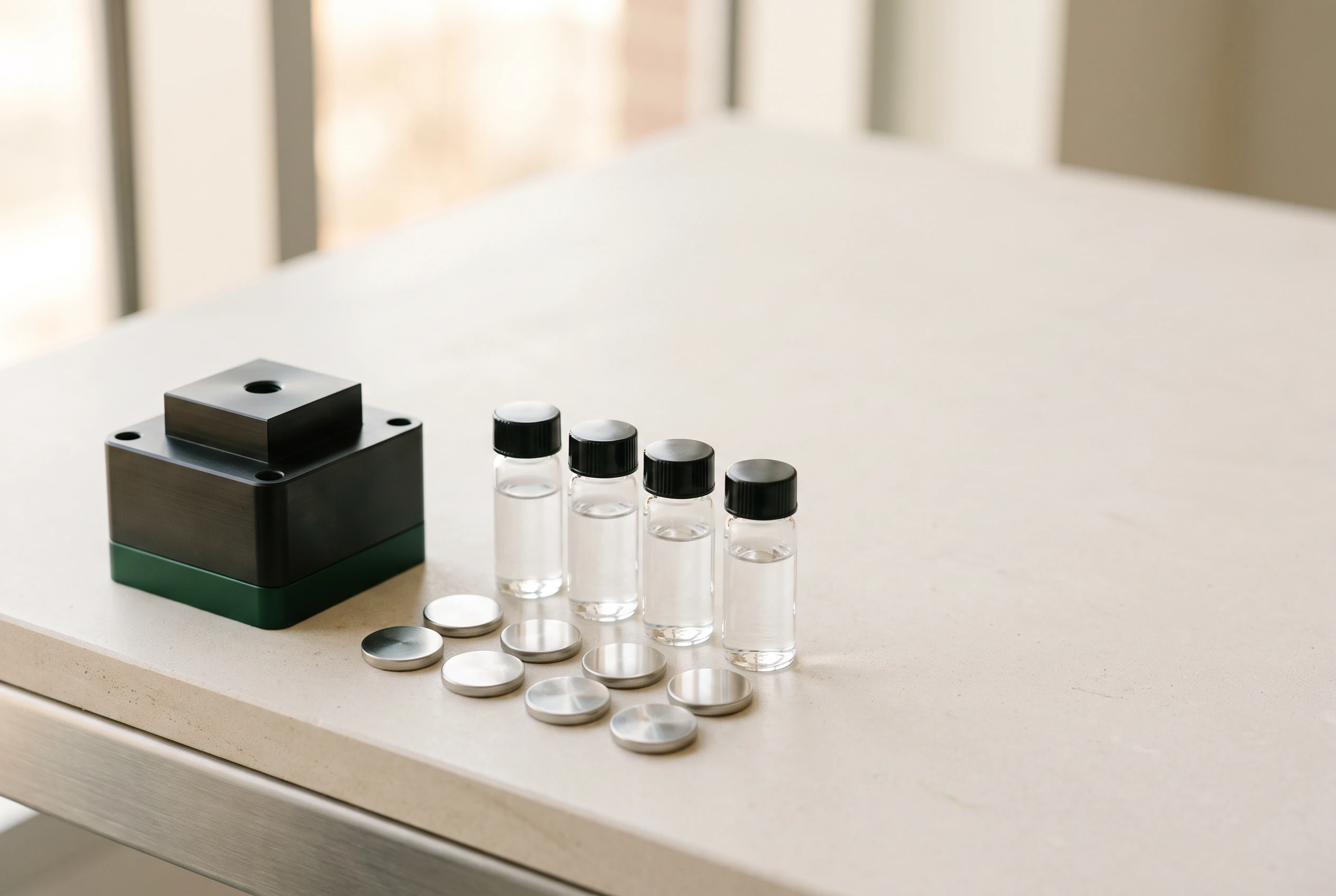 Enlarge imageEnlarge: CNC-machined multi-channel aluminum thermal test block beside blank stainless-steel coin-cell casings and glass electrolyte sample vials.
Preparing enough cells for the tests
Researchers compared subtle changes in battery anode and cathode formulations—milling candidate materials in ball mills and screening them inside coin cells. Rather than buying new automation from scratch, I pulled an unused liquid-handling robot out of storage, designed custom sample holders for the lab’s vessels, and built a LabVIEW interface that went into daily lab use. I also tested whether the robot could coat substrates with battery slurry, building a motorized flame-treatment stage and testing surface treatments alongside vibration to see how far a modified liquid handler could go before dedicated coating equipment was needed.
Manual cell assembly at the lab hoods called for a practical bench fix. I designed multi-cell holding fixtures that sat inside pre-loaded component trays, paired with a manual suction tool to transfer parts across multiple cells at once and a 5S workstation layout that kept everyday tools within easy reach—making repetitive builds easier on technicians and increasing daily cell output.
Setting the temperature of each test
I designed thermal hardware with independently controlled coin-cell positions and built its controller around Wildcat’s existing electrical test equipment. Across several weeks of hardware-in-the-loop tuning covering heating, cooling, temperature measurement, and control techniques, the system achieved temperature stability within 0.03°C.
Planning a redesign of the battery-test software
Alongside the hardware and LabVIEW work, I helped plan a redesign of Wildcat’s battery-test software—starting with conversations with the researchers and technicians who used it every day, and working with software engineers to translate their needs into a proposed system architecture.
Together we mapped how staff would use the software, the data it needed to accept and produce, and its interfaces to Wildcat’s test instruments—including validation on the instruments alongside optional documentation and training so the company’s engineers could maintain and adapt it over time.
Experience used here
High-throughput screening · Mechanical design · Custom assembly tooling · Laboratory automation · LabVIEW · Process development · Control engineering · Thermal control