Telesis Bio & Eton Bioscience
Developing the SOLA Oligo Printer
Director of Engineering Innovation · 2021–2022
Colleagues developing the synthesis chemistry at Telesis Bio had built a promising enzymatic process using SOLA technology to assemble DNA from short strands; the challenge was turning a moving laboratory protocol into a reliable, automated machine. Liquid handling, thermal cycling, plate movement, and consumable sealing all interacted—any change in chemistry rippled directly into the machine’s footprint, throughput, and upkeep.
I recruited and led an eight-person internal innovation team, set up our engineering lab and prototyping shop, and directed an outside contract-engineering partner to turn that chemistry into three working beta instruments.
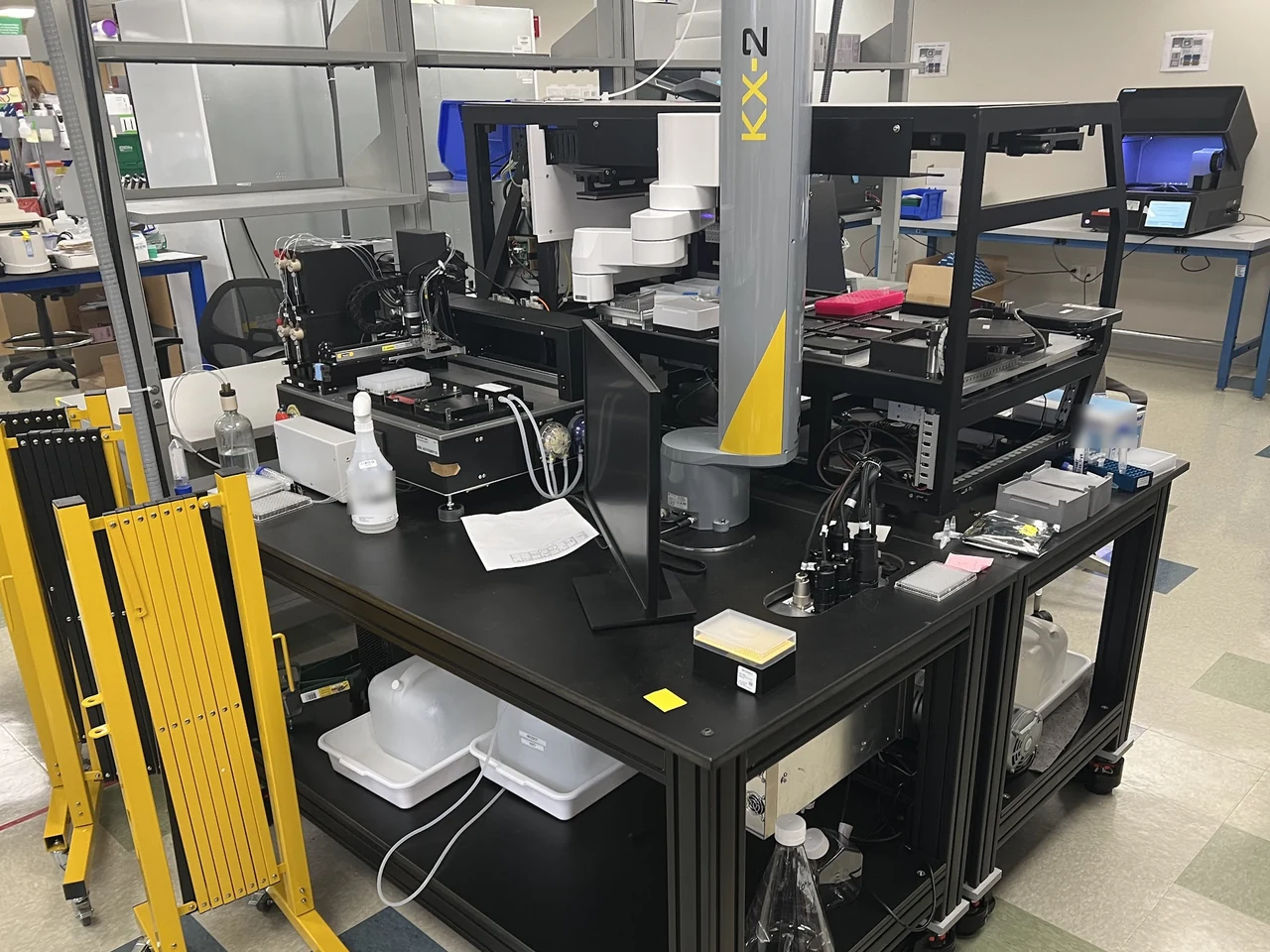 Enlarge imageEnlarge: Oligo Printer beta workcell with a central robot and surrounding laboratory stations.
Beta instruments delivered
Engineering-team result, on time and under budget, 2021–2022.
Comparing methods before committing to a machine
Instead of locking in a complete machine design on paper, I structured the early schedule around parallel, low-cost breadboard setups so our internal engineers and contract partner could test competing liquid-handling concepts quickly.
I led the tradeoff reviews weighing unit cost, development risk, thermal capacity, sample throughput, and deck footprint across the whole instrument. When one high-speed pin-transfer approach looked great in throughput estimates but produced inconsistent droplet measurements on the bench, I set explicit validation gates—requiring proof of repeatable volume transfer with zero well-to-well cross-contamination—so we committed capital to an economical architecture we knew could hold up.
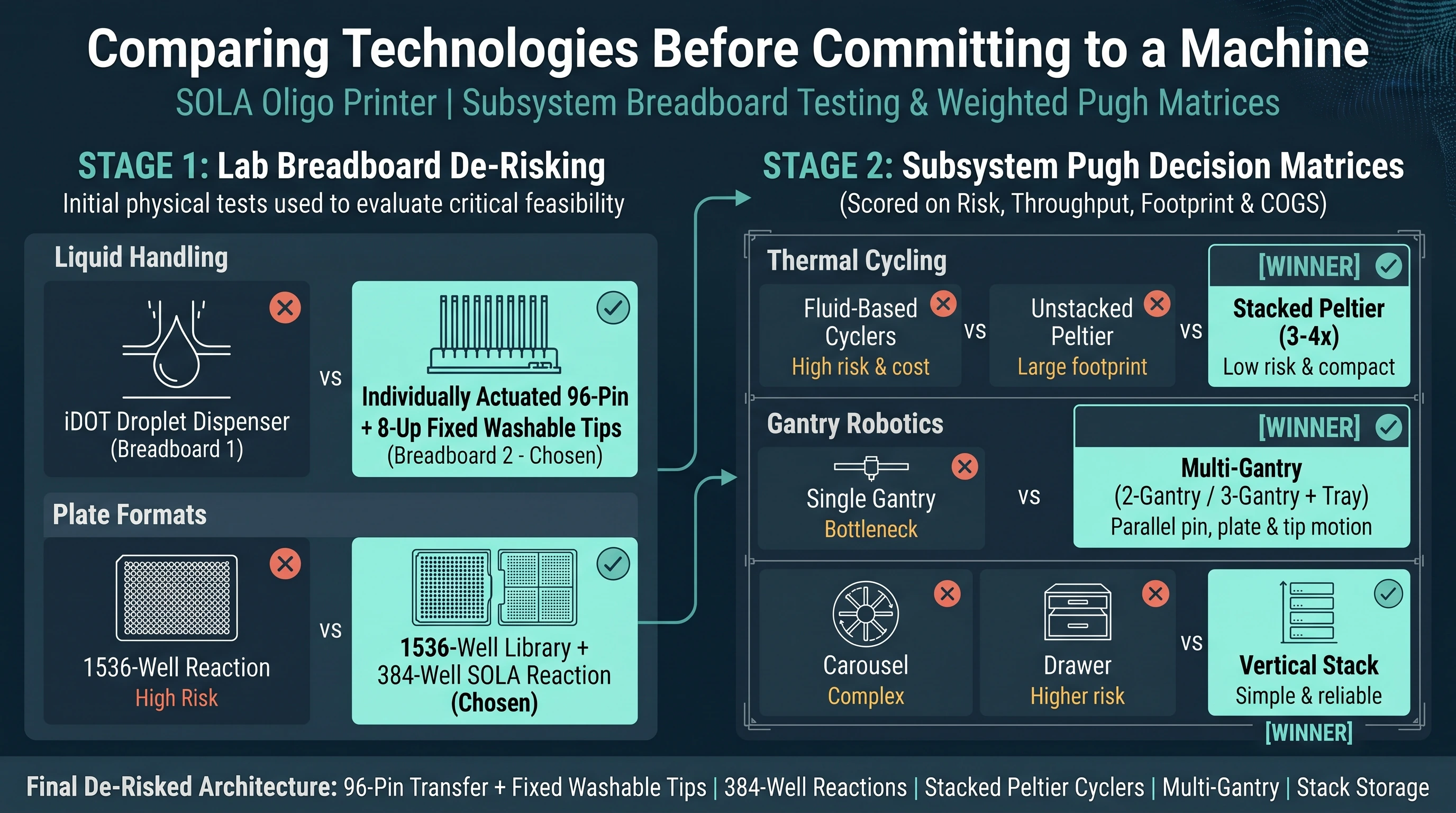 Enlarge imageEnlarge: Comparing Technologies Before Committing to a Machine — SOLA Oligo Printer Subsystem Breadboard Testing & Weighted Pugh Matrices
Instrument architecture and ergonomics
An automated workcell still fails if it is painful for a human technician to load, clean, maintain, or recover after a dropped plate. In architecture reviews with teammates working on the chemistry and our contract engineers, we weighed compact vertical stacks against radial layouts built around a central robotic arm.
We selected a swing-open front input rack, developed with our engineering partner, that presented plates cleanly to the operator at the front of the machine while tucking bulk reagent carboys and waste containers safely beneath the bench—verifying robotic reach and gripper clearances right alongside operator access.
Developing the systems
While layout studies and chemistry optimization moved forward, I oversaw our external partner’s system and electronics work and focused internal engineering onto the highest-risk mechanisms. Locking down clear mechanical, electrical, and software interfaces early let both teams develop plate handling, dispensing heads, and thermal stations in parallel while teammates handling the laboratory methods retained ownership of the biological process.
To protect our delivery date, we deliberately scoped the first build as a standalone benchtop machine where an operator removed finished plates—reserving physical space and ports for future robotic handoffs without letting multi-instrument automation slow down our first beta units.
Delivering three beta instruments
Testing the riskiest liquid-handling and thermal mechanisms early—and keeping automated handoffs to downstream instruments out of the first benchtop scope—kept integration surprises from derailing the schedule. Our internal team and contract-engineering partner brought the mechanics, electronics, software, and synthesis chemistry together to deliver all three beta instruments on time and under budget.
Experience used here
Team development · Engineering leadership · Product requirements · Architecture studies · Prototype experiments · Development planning · Supplier coordination · System integration