Synthetic Genomics
Developing an instrument for RNA production
Senior Systems Engineer · 2016–2018
Colleagues developing the RNA chemistry at Synthetic Genomics were working on a multi-step process to convert a DNA template into purified RNA. I designed the automated instrument around that workflow, iterating closely with teammates at the bench and outside microfluidics suppliers as the disposable cartridge and the machine around it evolved together.
Automating the protocol meant more than pipetting: the system had to meter reagents on cue, hold hot and cold zones side by side, and circulate product through a purification membrane—all while moving toward a cartridge economical enough to replace after a single run.
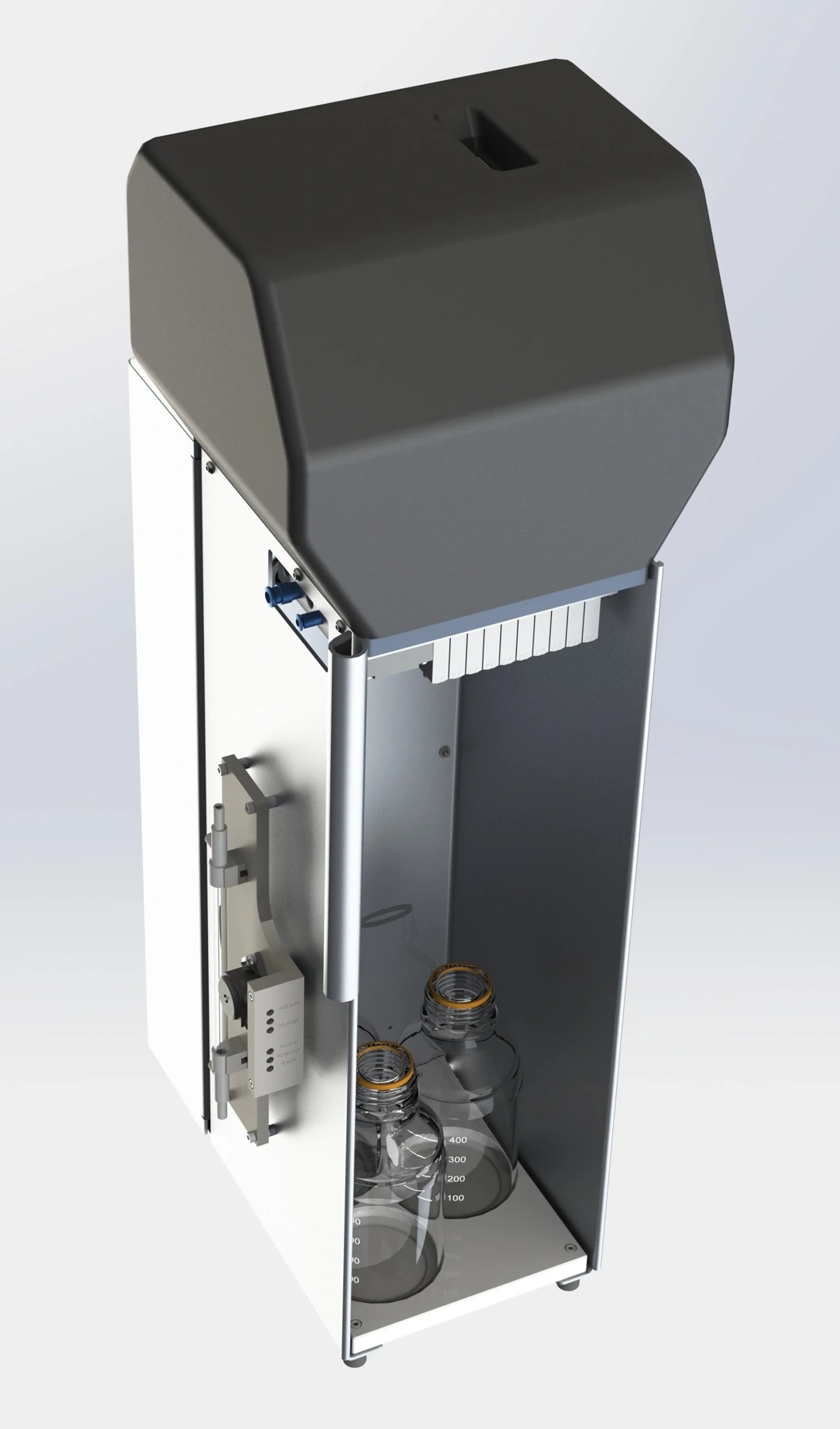 Enlarge imageEnlarge: Full-instrument CAD assembly of the sealed RNA production system and lower fluidics bay.
From machined parts to a disposable cartridge
My initial benchtop rig used machined manifolds, discrete solenoid valves, fittings, and tubing to route fluids into a reaction vessel—a fast way to help the team develop the protocol at the bench, but far too expensive and labor-intensive to treat as a disposable consumable.
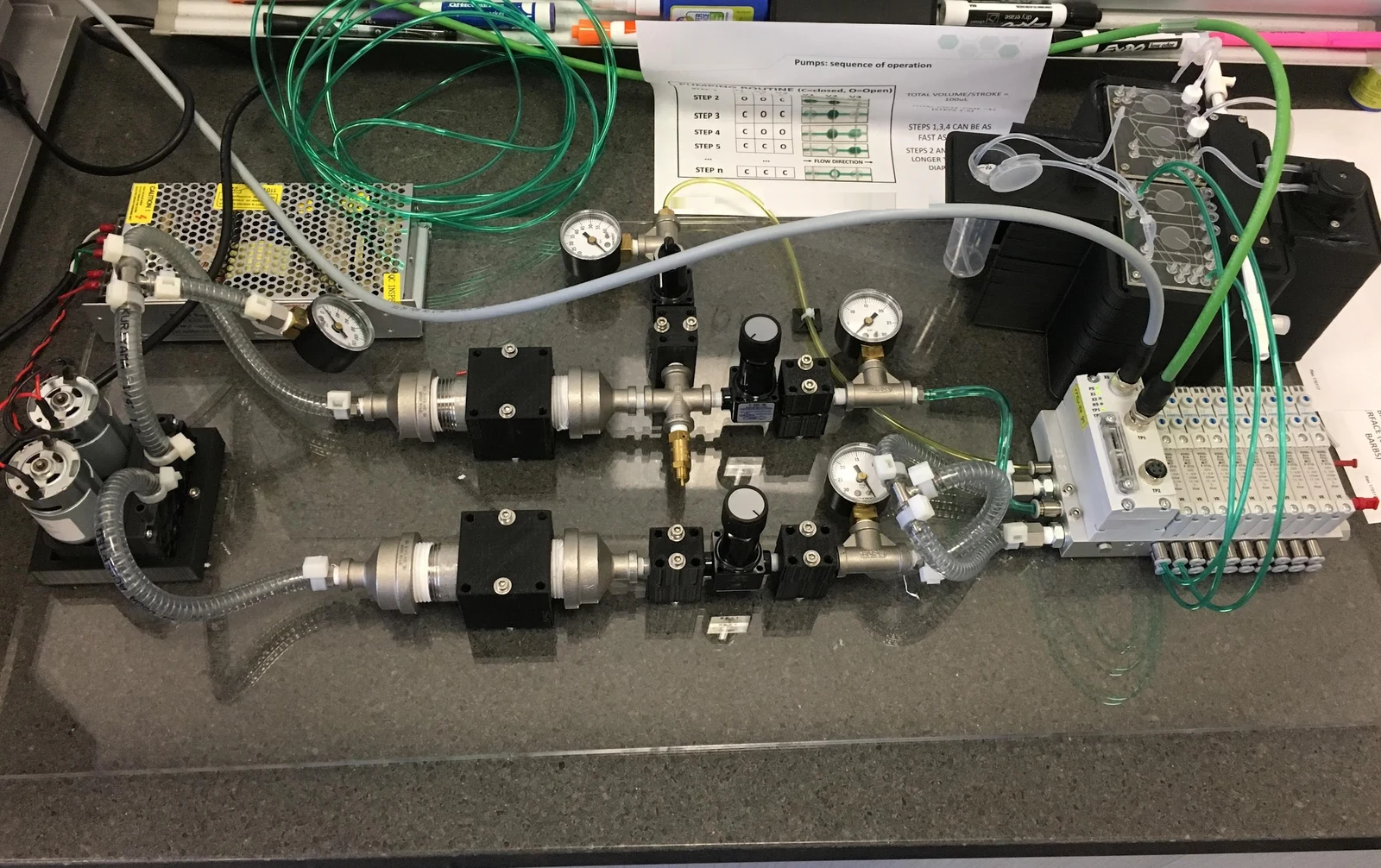 Enlarge imageEnlarge: Benchtop RNA tangential-flow filtration (TFF) microfluidic prototype at Synthetic Genomics, integrating dual pumps, inline pressure regulation, a pneumatic valve manifold, and the multi-chamber microfluidic filtration cartridge.
Working with an outside microfluidics supplier, we redesigned the fluidics to consolidate separate manifolds, replace external valves with onboard pneumatic fluid controls, and strip out manual tubing connections while keeping cartridge loading simple for an operator. Together with our team, the supplier built and shipped a working proof-of-concept cartridge demonstrating fluid routing through integrated valves and pumps—setting up the next iteration to bring the reaction chamber onto the card while keeping the circulation pump and filter membrane external.
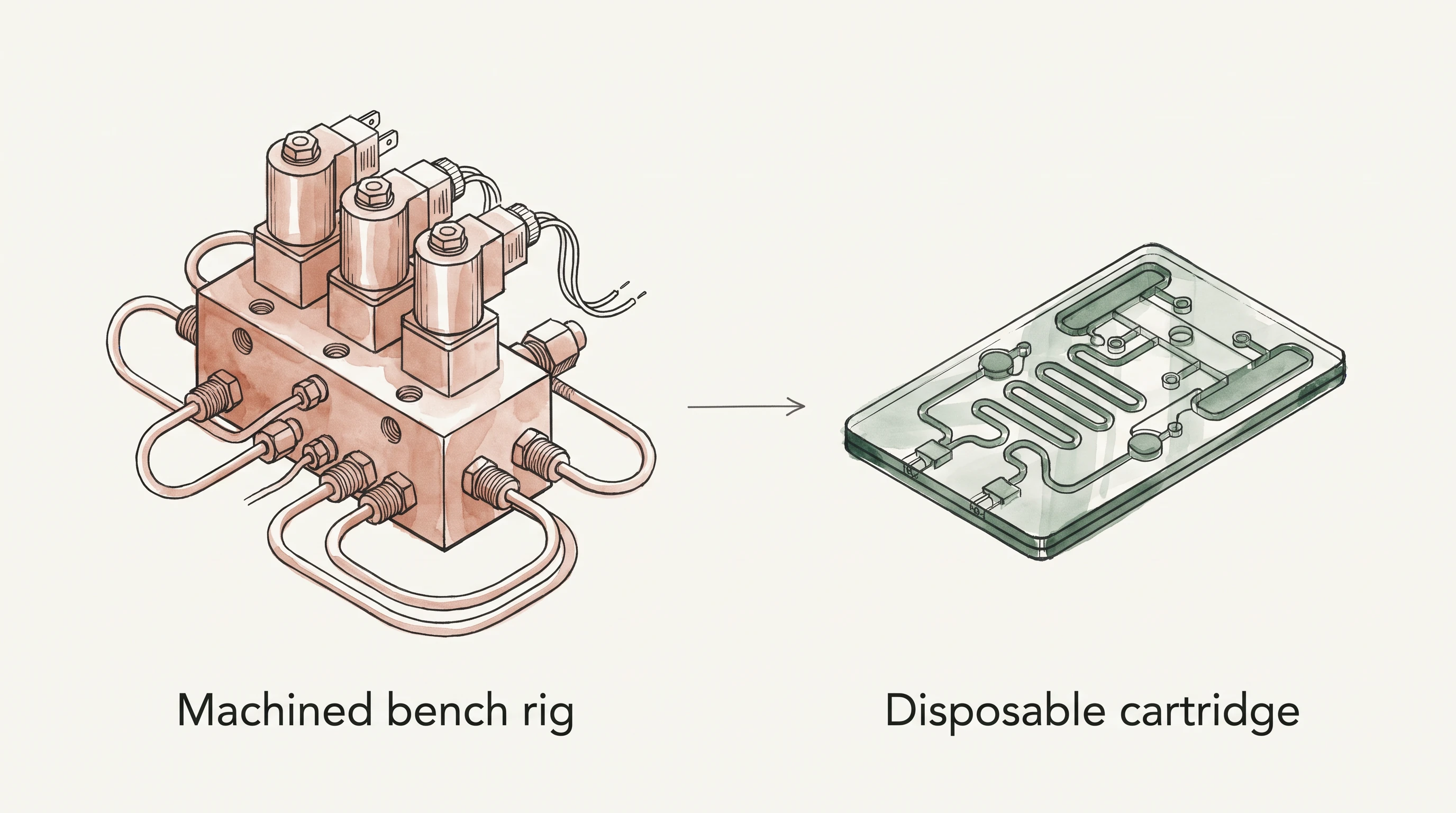 Enlarge imageEnlarge: Consolidating discrete machined manifolds, external valves, and manual tubing into a laminated pneumatic cartridge created a practical path toward a single-use consumable.
Connecting the scientific process to the hardware
Purifying the RNA mid-process drove key parts of the machine architecture. Using tangential-flow filtration, the instrument circulated liquid across a membrane that retained larger RNA molecules in the reaction loop while washing smaller reaction byproducts out to waste and exchanging the surrounding buffer.
Temperature control created a second tight interface: the reaction zone needed active heating right beside chilled storage keeping sensitive enzymes cold until the moment they entered the reaction. I designed the mechanical support, clamping mechanism, electrical hardware, and pneumatic controls that pressed the cartridge repeatably against the thermal zones while mating its fluidic and air ports.
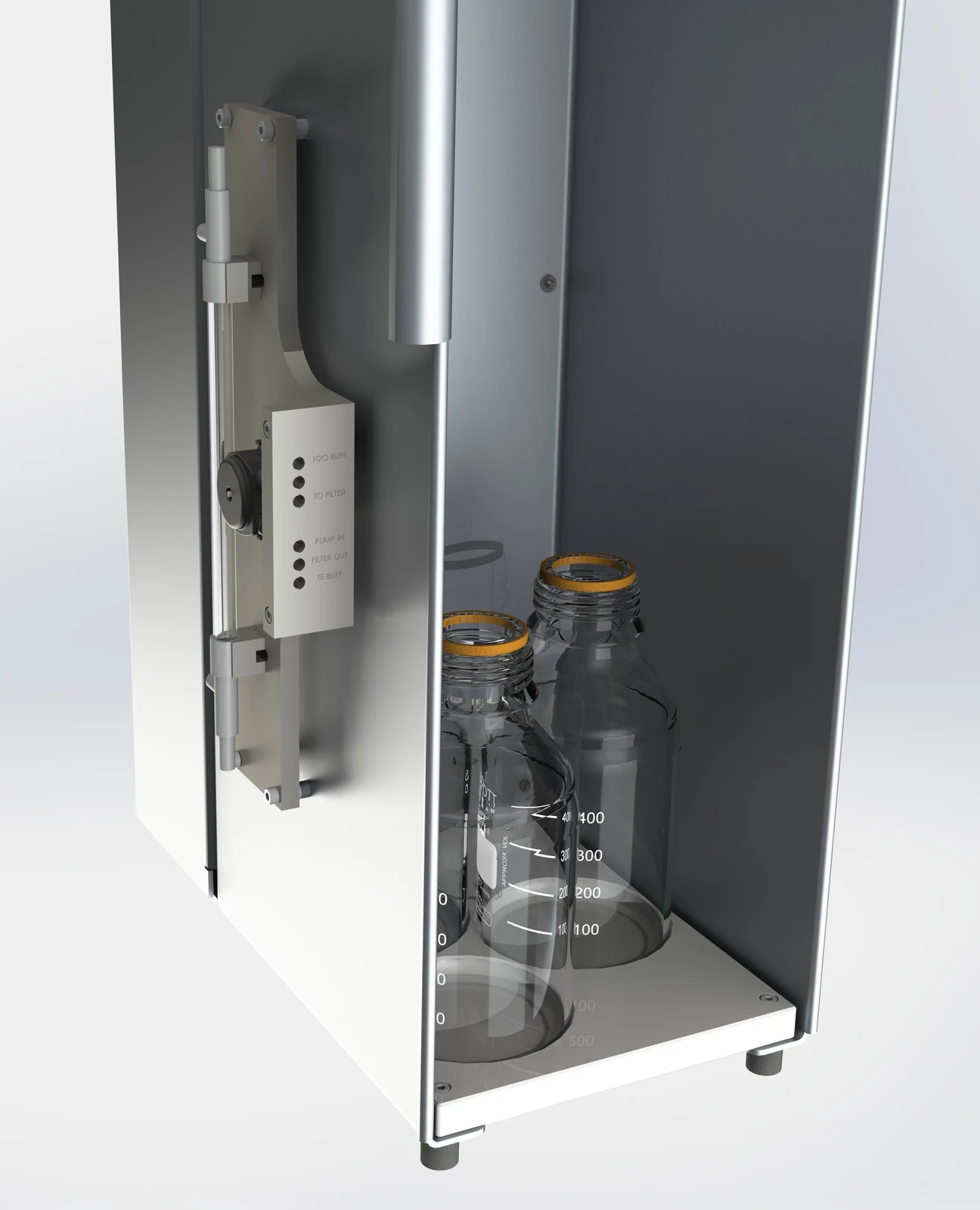 Enlarge imageEnlarge: Rendering of the RNA instrument’s lower section, with a connection block and two fluid bottles.
Connecting the instrument to the DBC
Because RNA synthesis starts from a DNA template, this instrument sat directly downstream of DNA synthesis and DNA assembly inside the larger Digital-to-Biological Converter (DBC) program.
We architected the control system so the RNA unit could operate either as a standalone benchtop machine or as an integrated station inside the DBC workcell—with software specialists writing the control routines around the hardware and pneumatic interfaces I defined. Individual process stages, including DNA-to-RNA conversion, were demonstrated while our teams updated motion-controller and valve communications for full DBC workcell integration at the close of my tenure in 2018.
Experience used here
Mechanical and electrical design · CAD · Microfluidic-device development · Pneumatics · Thermal control · System architecture · Vendor coordination · Instrument integration