BenchSwap
Designing BenchSwap around the experiment
Founder & CEO · 2026–present
The inspiration behind BenchSwap was to bring Airbnb-style flexibility to a faster, more modular kind of science: instead of signing a multi-year lease, a research team could book bench space for just a few weeks, add an incubator or a shaker if the experiment called for it, and bring in a consulting specialist for a few hours of guidance when needed.
Turning that flexible vision into working software meant designing for realities a vacation rental never faces—when you check out of a room, your luggage leaves with you, whereas a researcher’s living cells stay in an incubator and their samples stay in a freezer between visits. I wrote the product specifications and directed AI coding agents to build around both sides of that problem: prototyping modular space, equipment, and specialist configurators while shaping an experiment-first intake for our live beta.
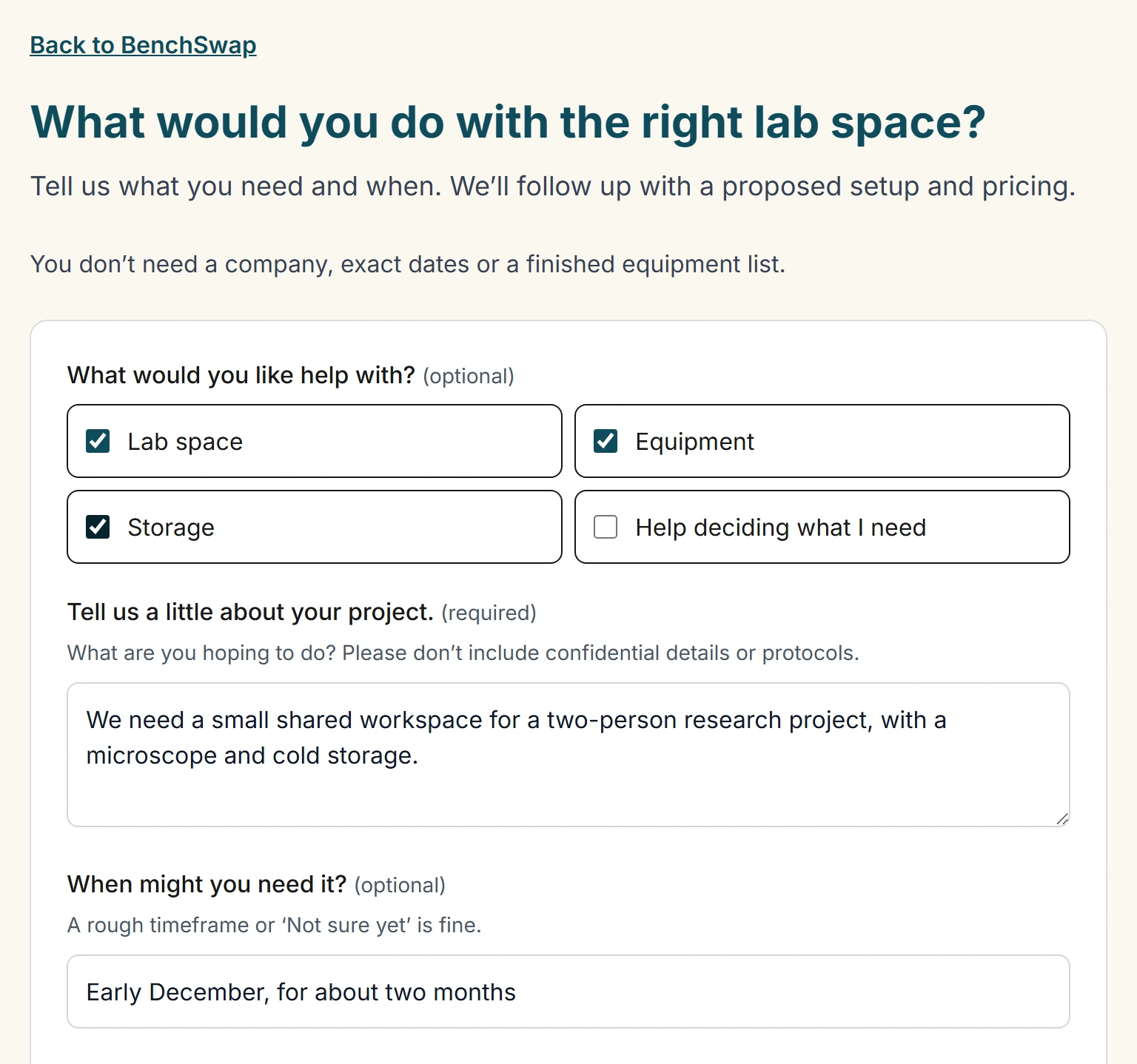 Enlarge imageEnlarge: BenchSwap project intake flow matching experimental requirements with laboratory space, equipment, and storage.
Adapting flexible booking to how researchers actually plan work
When someone books a place to stay for a week, they already know what they need. A research team planning a short sprint of experiments can arrive at two very different stages: one researcher already has a finished protocol and knows the exact biosafety level and add-on instruments to ask for, while another has an early hypothesis—or a computational model that needs wet-lab validation—and wants a few hours with a specialist to scope the experiment before choosing gear. Even with a defined protocol, a photo of an open bench doesn’t tell you whether a host’s instruments have the exact measurement capability an assay requires.
To make flexible access work for both groups, I designed our website intake around the project rather than static property listings. Researchers with a defined protocol can specify their space and equipment add-ons directly, while founders with an earlier idea can start with rough dates and an incomplete list—with a separate registration path as we build out our specialist network.
Rather than pretending a multi-part lab setup can clear instant self-checkout, the live website captures what the team wants to accomplish and hands it to us to confirm scientific fit, equipment availability, safety requirements, and host terms. That gave real prospects an easy starting point immediately while we learned from every inquiry.
Layering on equipment and accounting for work between visits
Modular lab access also means separating when someone is at the bench from what their experiment occupies the rest of the week. A team running a three-week study might only need a workstation two days a week, while its cells occupy an incubator and its samples take up minus-80 freezer space every single day—alongside add-on instruments like a shaker or plate reader needed for specific steps.
I built continuing storage and modular equipment choices directly into our intake questions and configurator prototypes. Those prototypes tested how a team could combine shared instruments, dedicated add-on gear, and equipment they brought themselves—even when the bench space and individual instruments ran on different schedules.
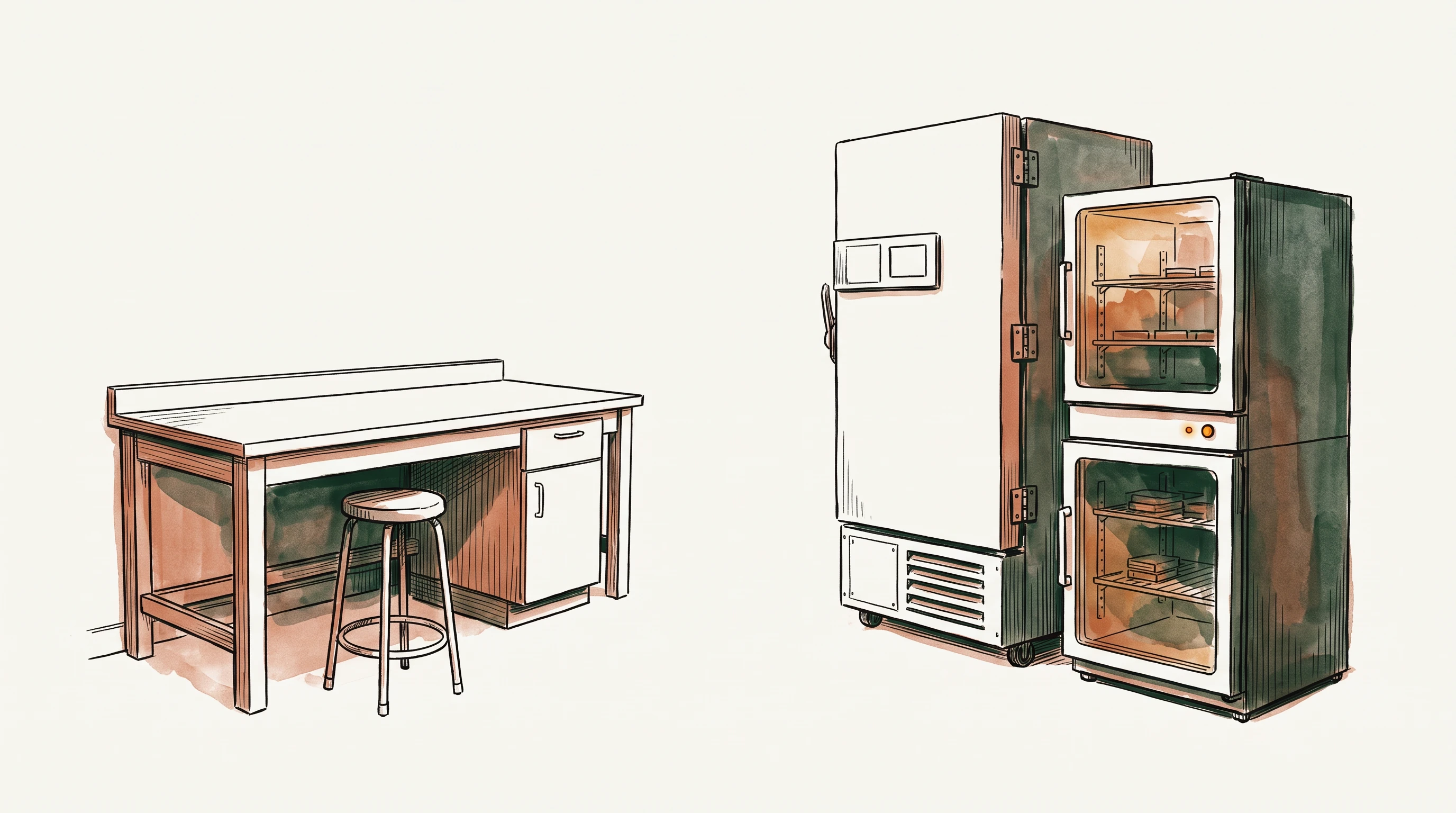 Enlarge imageEnlarge: Even when a researcher only books a bench two days a week, living cells remain in the incubator and samples occupy freezer space every day in between.
Walking through those prototypes by hand with my operations cofounder also exposed places where rigid software rules undercut that flexibility. During one test, I caught a defect that prevented a user from selecting individual workstations without first renting an entire multi-seat bench. I directed the coding agents to fix the selection and pricing logic so a small team could book only the seats and add-ons its project actually needed.
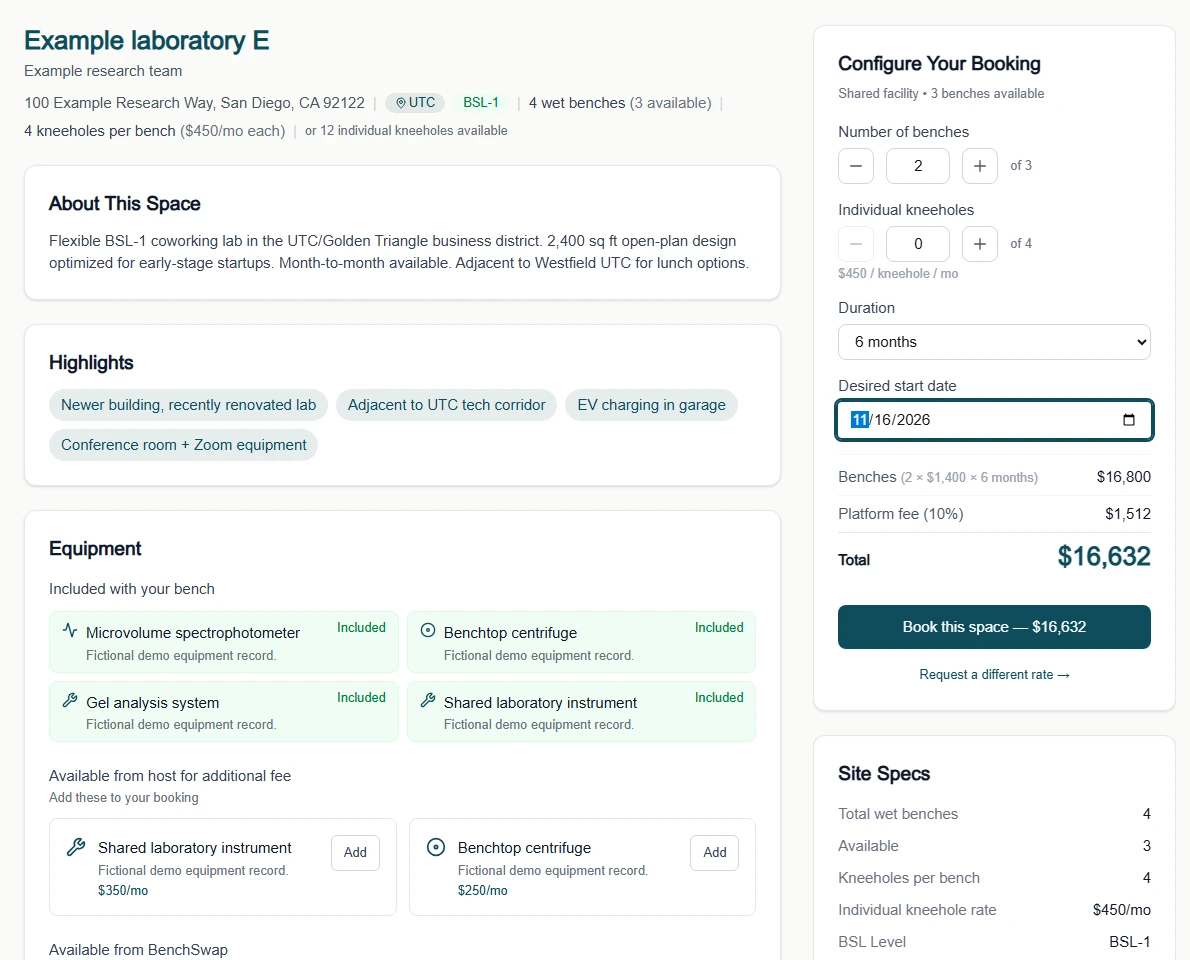 Enlarge imageEnlarge BenchSwap host bench and shared equipment configuration interface
Prototyping the full vision with AI—and launching lean
Using AI coding agents let me turn product ideas into working software in days without waiting to hire an engineering team. I wrote the specifications, set the visual direction, tested every workflow from the customer, host, and operator seats, and directed fixes for misleading price displays, mislabeled safety questions, and signup friction.
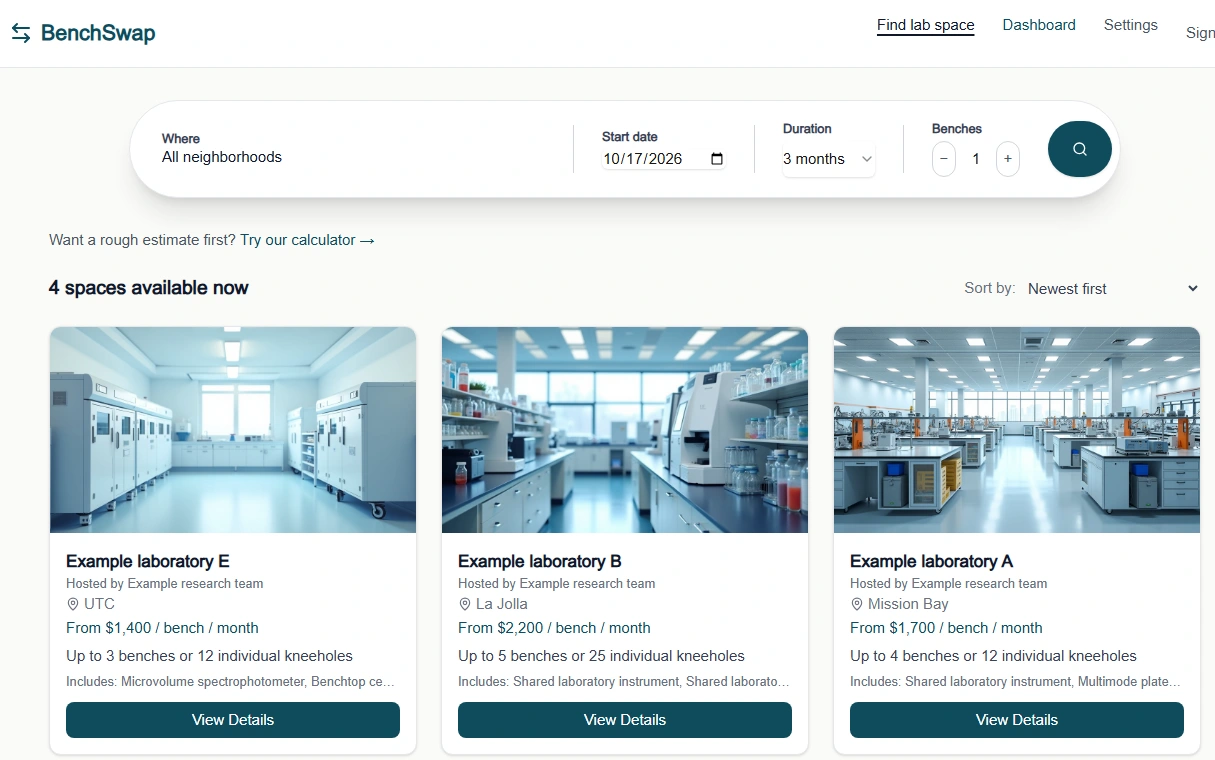
Our earliest full-stack prototypes mapped out the complete on-demand vision—browsing spaces, configuring modular equipment, exploring specialist support, and stepping through agreements using fictional listings. After spinning out a preview for a real prospective host lab and seeing in customer conversations how much hands-on coordination went into matching an experiment to equipment and host terms, I streamlined the public website into the fast, guided project-request flow live today.
With a two-person team, helping our first customer get into a working lab mattered more than maintaining a complex automated platform. Prototyping ahead with AI let us test the modular vision, launch a practical front door for real inquiries, and see clearly which recurring coordination steps are worth automating next.
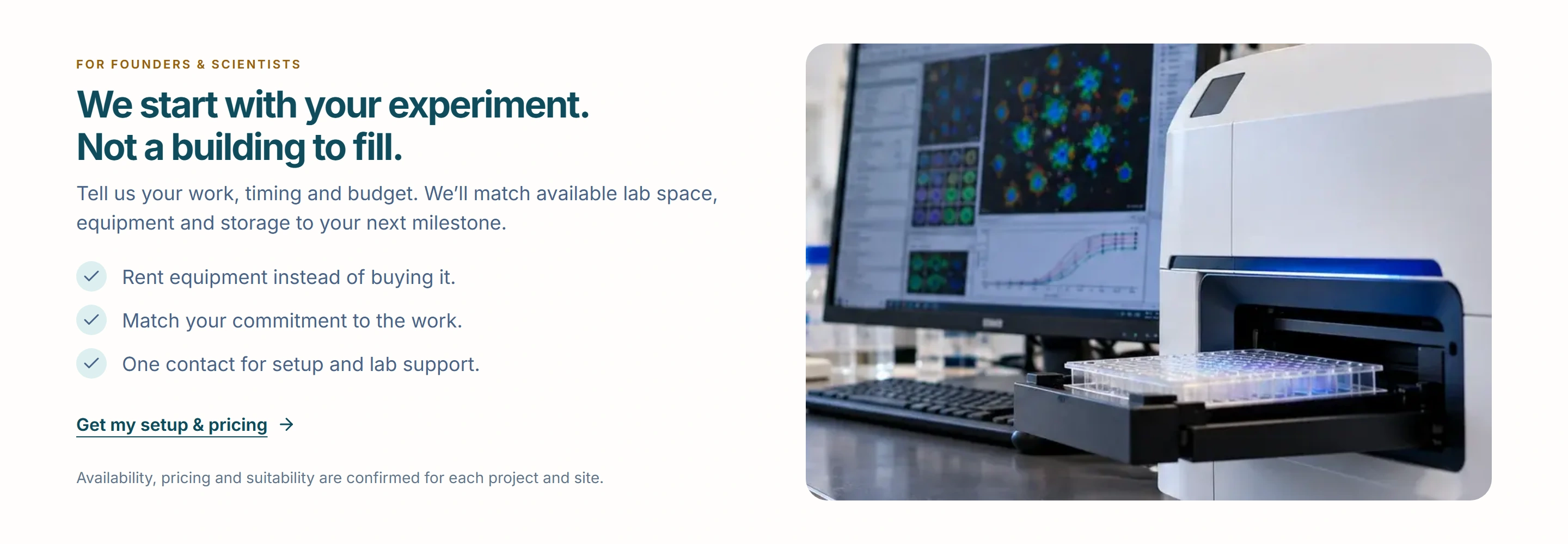
View the earlier marketplace concept
An earlier marketplace prototype
Our early full-stack prototype explored the initial Airbnb-inspired marketplace experience—browsing lab spaces, choosing individual workstations, and layering on equipment and agreement steps online—before we streamlined the live beta around guided project intake.
Experience used here
Product design · Research requirements · User experience · Cost modeling · AI-assisted development · Software testing