BenchSwap
Building BenchSwap’s business
Founder & CEO · 2026–present
Today’s early-stage research teams often need a lab for a few weeks or months to hit a milestone—adding an incubator, a shaker, or cold storage where needed, and tapping outside scientific help without taking on a multi-year lease. I built BenchSwap’s outreach, partner network, and financial model around pulling those modular pieces together quickly.
That approach took us from a short post in a local founder community to our first placed customer, an agreed recurring placement fee, and our first invoice—while teaching us where to adapt our pricing, partnerships, and hiring plan along the way.
 Enlarge imageEnlarge: Vacant San Diego laboratory bench space—built for multi-year tenants, while early research teams often just needed a few weeks of modular access.
Reaching teams when they needed a lab
Instead of waiting for startups to enter a traditional real-estate search, I went to the places where a short-term or project-based lab need first appears: a team spinning out of a university, a new grant funding a key experiment, or a startup outgrowing an incubator.
To reach those teams early, I approached founder communities, university programs, advisers, and brokers. For one San Diego founder community, I wrote a short introduction its organizers could drop straight into their member feed—inviting researchers to reach out even if they didn’t have a finished equipment list yet. Our first placed customer came directly from that post and soon referred another founder.
When different groups raised questions, I adjusted the offer. For a university entrepreneurship program, I built examples around very small teams and stays as short as a week—explaining why ultra-short stays carry higher daily rates when safety review and onboarding happen upfront. When a commercial broker worried that short-term placements might disrupt an owner’s existing brokerage relationship, I updated our host pitch to show how temporary occupancy could run alongside a conventional lease search—and protect the broker’s role if that startup grew into a long-term tenant.
Working through the first customer’s requirements
The founder who found us through that community needed occasional bench time for cell work, full-time incubation and cold storage between visits, and specific measurement and imaging instruments on a tight budget. Working with my cofounder and equipment suppliers, I separated what the team already owned from the add-on gear we needed to source and put together options.
When the first full quote came in above their budget, I looked at starting with bench space alone and adding equipment later. The founder made it clear why that wouldn’t work: without the core instruments on day one, they couldn’t run a single experiment. A cheap bench is useless if the science can’t happen.
At the same time, our original plan to contract directly depended on host terms, equipment availability, and a commercial insurance quote whose minimum annual cost was far too high for a single small placement. Rather than letting our own setup stall the customer, I changed course and introduced the team to a host facility that could lease to them and bill them directly. My cofounder led the tour, the customer signed with the host, and I negotiated a recurring placement fee and sent BenchSwap’s first invoice—turning an early roadblock into a working commercial arrangement.
Making the arrangements work for each participant
Giving researchers flexible, modular access meant aligning partners with very different incentives. I worked with lab hosts, brokers, legal counsel, and an environmental health and safety specialist to set clear rules for site access, safety reviews, and equipment care. With equipment suppliers, I structured ways to rent out idle instruments while keeping them available for sale, and turned my cofounder’s initial equipment list into complete package specifications—covering shared versus dedicated use, accessories, and setup—for suppliers to price and confirm.
Customer conversations also opened two additional ways to serve flexible projects:
- Adding specialist execution and advice: Some teams needed a few hours of hands-on bench support or specific tests run for them rather than renting space to do everything themselves. I negotiated referral terms by email with a laboratory-services provider, separating published prices on routine tests from custom-quoted bench support and research projects, and fixing conflicting turnaround times in their draft catalog while we prepared the final agreement and site listings.
- Keeping a group of startups together: When a broker introduced a group of biotech founders looking for their next lab home, I built a tailored proposal around keeping their community intact and sharing equipment—giving the lead founder an easy package to circulate to the group as an ongoing opportunity.
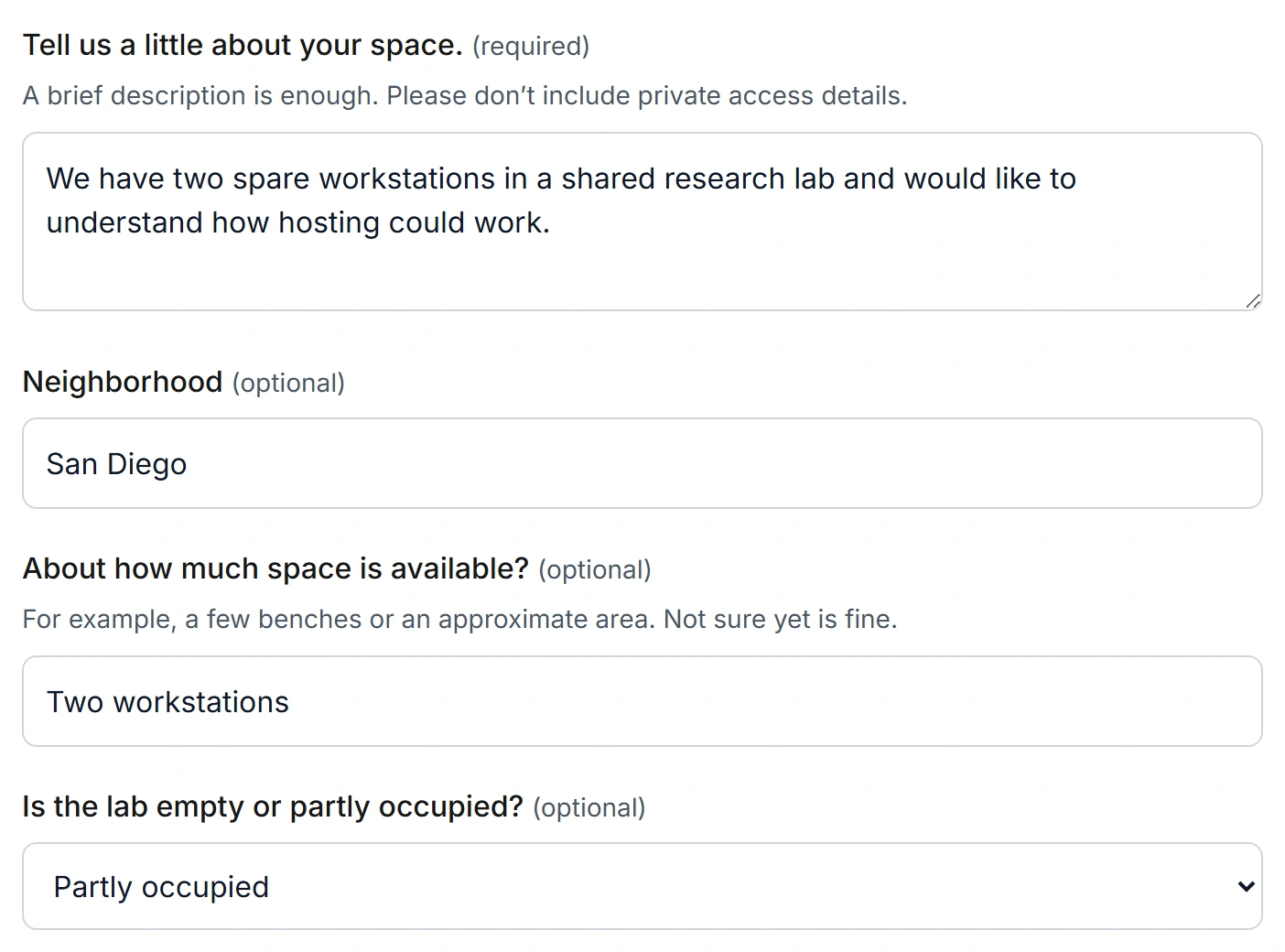 Enlarge imageEnlarge BenchSwap host space onboarding and multi-bench management view
Changing the plan when the numbers changed
I built our financial models to test what the business could actually afford, and changed the plan whenever the numbers pushed back. When more realistic sales timing pushed projected break-even out, I delayed planned hiring until revenue could pay for it, and made proven customer demand a requirement before taking on empty buildings with fixed rent. When an adviser challenged my assumption that graduating startups would later come back as lab hosts, I stripped that assumption out of our base forecast so the business didn’t depend on wishful thinking.
I also separated total customer spending from the share BenchSwap actually kept after paying providers, and split future ideas—like supply purchasing and full lab management—away from the core space-and-equipment service so each stood on its own numbers.
Alongside the customer work, I incorporated the company, set up our equity and stock plan with counsel, and recruited an operations cofounder on a part-time commitment that scales to full-time with funding—keeping us lean and focused on closing real arrangements first.
Experience used here
Company building · Customer discovery · Commercial negotiation · Financial modeling · Partner development · Team building