RapidRealities
The tools behind a machining quote
Product requirements and development direction · 2014–2015
RapidRealities was already quoting parts from 3D files and matching orders with open machine-shop capacity; our 2014–2015 portal work focused on giving estimators every piece of job context in one screen—and keeping quotes organized when customers revised their designs midstream.
I specified the customer upload flows and staff estimating fields, worked through real machining cost drivers with our manufacturing partner, and mapped the state transitions linking customers, our team, and partner shops from quote to delivery.
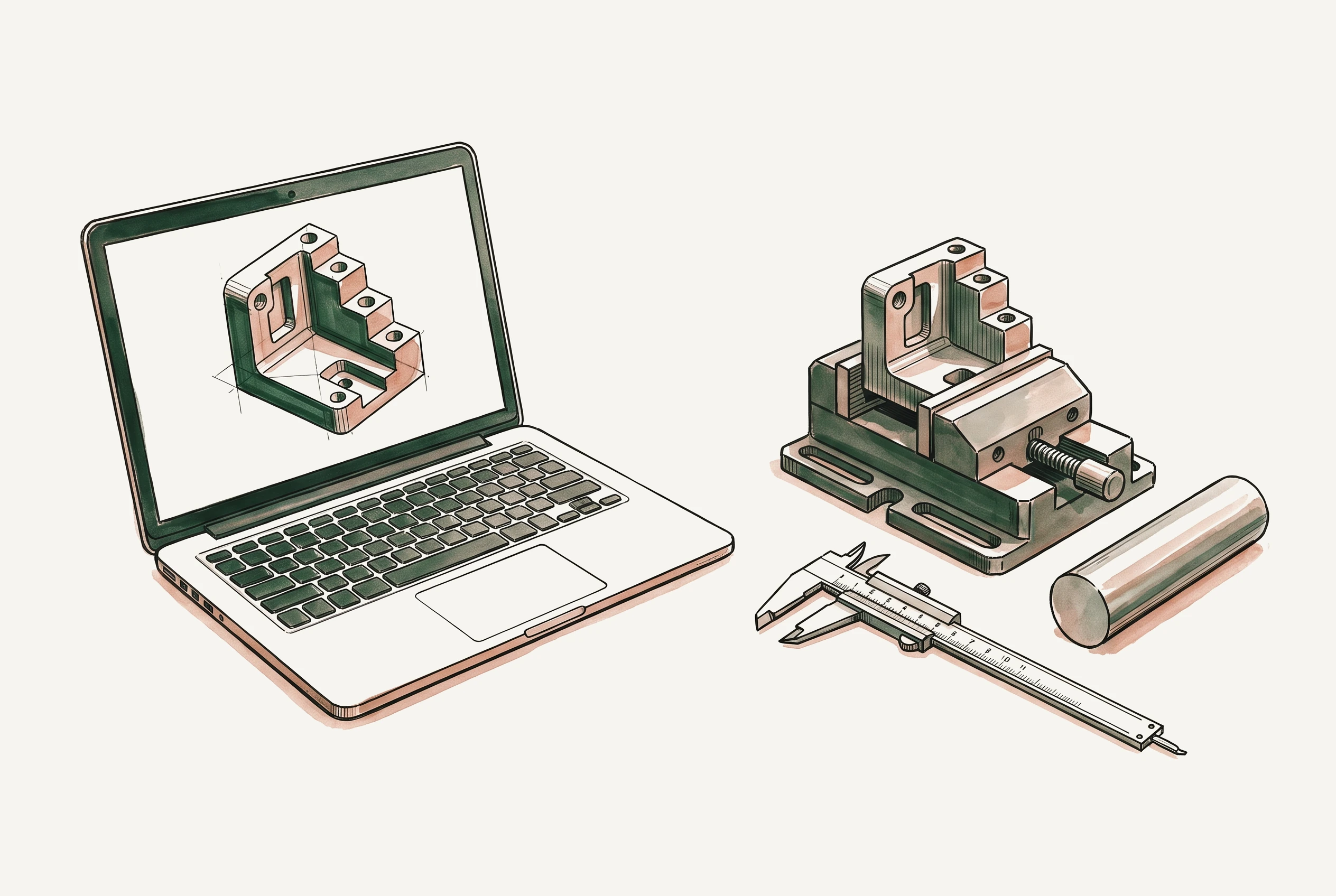 Enlarge imageEnlarge: Pen-and-ink and watercolor illustration pairing a 3D CAD bracket model on a laptop screen with the physical CNC-machined bracket held in a milling vise.
A part file was only the start of the request
A 3D CAD file defines geometry, but quoting a real job requires material specs, quantities, target delivery dates, and 2D engineering drawings carrying tolerances the 3D model doesn’t show. I designed the intake flow and staff quoting view to keep all of those files and requirements attached to one record.
Live orders also showed that hardware quoting rarely stays static after the first upload: in 2014, seeing customers email revised CAD files after submitting an initial request led me to add direct model-revision uploads inside active portal threads—alongside queue-triage controls so staff could claim incoming jobs or pass cleanly on out-of-scope work.
Accounting for the real work of machining a part
A realistic CNC quote has to capture fixturing setup and CAM programming right alongside raw material and spindle time. Working with our manufacturing partner, I built those specific cost inputs directly into the staff estimating tool.
Because a machinist still needed to check part geometry for tricky setups or tight features, our architecture deliberately separated instant geometry-based pricing for 3D printing from rapid, human-reviewed quotes for CNC machining.
Making the next action unmistakable from quote to shipping
In 2015, I mapped every responsibility and handoff between the customer and RapidRealities—preparing a bid, approving an order to proceed, running production, and shipping—giving our software developers a clear state machine for statuses and next-step prompts inside the order portal.
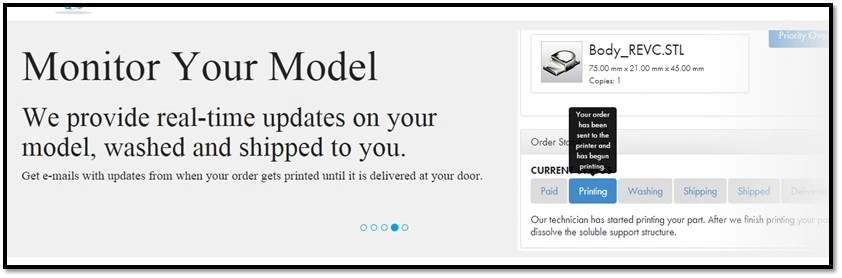
The retained 2014 interface excerpt below paired a 3D part preview (Body_REVC.STL) with live stage tracking through printing, washing, and shipping—establishing the transparent order-progress view we carried forward alongside manual shop-capacity matching while automated multi-shop scheduling remained a future goal.
Experience used here
Product design · Manufacturing quotations · Customer experience · Capacity matching · Software requirements · Development direction